
Looking Ahead This Week: September 7, 2026
The September 15-16 FOMC meeting is now squarely a live decision following Friday’s August employment report. Payrolls of +162,000 — with July’s catastrophic -23,000 print revised to a positive +21,000 — have handed the three hawkish dissenters from July’s meeting a powerful evidentiary foundation and restored the September hike as a genuine possibility. Markets will spend the week pricing the new probability distribution: before Friday’s report, futures were assigning a low probability to a September hike; after it, that probability has moved materially higher. Chair Warsh, who told Jackson Hole he was “committed to a discipline, not to a decision” and that the bank may have “work to do,” now has substantially stronger data supporting the hawkish case than he did ten days ago.
The August Consumer Price Index, due Monday September 14, will arrive the day before the FOMC meeting begins and will be the final significant data input before the committee makes its decision. August CPI will be heavily influenced by energy prices: with Brent crude trading above $90 per barrel for much of August, the headline print is likely to show an increase relative to July’s soft 3.4% reading. Whether core CPI — which stripped out energy to deliver a compelling 2.5% annual rate in July — can hold at or below that level will be a critical test of whether the labor market rebound and oil price surge are combining to rekindle the broader inflationary trend the Fed has worked to suppress. The combination of a strong jobs report, elevated energy prices, and an imminent FOMC meeting makes this week one of the most consequential for markets since the tightening cycle resumed.
Economic Data and Market Highlights: Week of September 2, 2026
Macro Backdrop
The shortened Labor Day week — U.S. markets were closed Monday, September 1 — delivered an employment report on Friday that fundamentally reshaped the September FOMC decision landscape. August non-farm payrolls rose by +162,000, dramatically exceeding the consensus forecast of +53,000 and representing the strongest monthly job creation since March. The breadth of gains was notable: Leisure and Hospitality added 62,000 positions, Food and Drinking Establishments 59,000, and Local Government Education rebounded 42,000 after the prior month’s sharp seasonal decline that had contributed to July’s misleading headline. Construction, manufacturing, and health care also contributed modest gains. The unemployment rate held at 4.1%, and wage growth was broadly in line with expectations at +0.3% month-over-month and +3.1% year-over-year — the lowest annual wage growth reading since May 2021, providing some comfort that compensation pressures are not re-accelerating.
Critically, the Bureau of Labor Statistics revised its two prior months upward by a combined +55,000: July’s reported -23,000 — a reading that had shaken the market’s confidence in the labor market and sent rate-hike expectations collapsing — was revised to a positive +21,000, and June was revised from +20,000 to +31,000. The net effect of these revisions is substantial: the three-month average job creation, which had appeared to have deteriorated to near-zero, is now approximately +70,000 — weak relative to the first half of 2026 but far from the contraction signal that July’s initial print had suggested. The Federal Reserve’s three hawkish dissenters from the July FOMC meeting, who had argued that the labor market did not support patience, have received a significant vindication. September 16 is now a genuinely live decision, not the formality that markets had begun to assume.
Domestic Equities
The S&P 500 eked out a gain of +0.13% in a holiday-shortened three-day trading week, with the August jobs report providing a complex and ultimately mixed message for equity markets. Information Technology led the way with +1.10%, as the sector’s recovery momentum — which began when the AI monetization narrative stabilized in early August — proved durable even in the face of the hawkish employment surprise. The NASDAQ 100 gained +0.41%. The out-performance of large-cap technology amid a renewed rate-hike discussion reflects in part the shift in investor sentiment over the summer: having absorbed and partially digested the growth-versus-profitability debate triggered by Q2 earnings, the mega-cap technology complex is finding buyers willing to look through near-term rate uncertainty to the AI-driven revenue trajectories that Apple, Amazon, and Microsoft have now demonstrated more concretely. Energy advanced +2.28% as Brent crude surged above $90 per barrel for the first time since May, driven by a combination of Strait of Hormuz supply constraints and a complex series of Iranian diplomatic demands that included a potential Oman-mediated safe-passage framework — language markets interpreted as simultaneously raising hopes and risks for the waterway’s reopening.
The week’s losses were concentrated in sectors most sensitive to higher borrowing costs and a softer consumer spending outlook. Consumer Discretionary fell -2.05%, pushing the sector’s year-to-date return to -1.34% — one of only two S&P 500 sectors in negative territory for 2026 alongside Communication Services at +1.37%. The strong August jobs headline may seem counterintuitive as a negative for consumer-facing stocks, but the market’s reaction reflects a straightforward calculus: a strong enough jobs report to revive September rate-hike expectations is also a report that suggests borrowing costs will remain elevated, compressing the affordability of major consumer purchases and the earnings multiples of discretionary names. Industrials fell -1.04% and Materials -1.42%, cyclical sectors that face similar headwinds from the renewed rate debate. The equal-weighted S&P 500 declined -0.74%, contrasting with the cap-weighted index’s +0.13% gain and illustrating once again the degree to which a handful of mega-cap technology names are carrying the broader market in a challenging macro environment.
International Equities
International equity markets were broadly flat to modestly negative for the week, with MSCI EAFE declining -0.16% as the combination of a stronger U.S. dollar — a natural consequence of the hawkish August jobs surprise — and elevated global rate uncertainty weighed on international returns for dollar-based investors. MSCI Japan was the standout exception, gaining +1.47% as the yen’s renewed weakness relative to the dollar provided a tailwind for Japanese exporters and the country’s domestically oriented corporate reform story continued to attract foreign capital. Japan’s year-to-date return of +22.44% has now surpassed the S&P 500’s +13.65% by a wide margin, making it one of the best-performing major developed markets of 2026. MSCI Germany fell -2.01% — its worst week in several months — as the dollar’s strength and the reacceleration of oil prices, a significant cost input for Germany’s energy-intensive industrial economy, combined to create a particularly challenging environment for European equities.
Emerging markets were modestly positive at +0.26% (MSCI EM), supported by selective strength in commodity-export-oriented economies that benefit from elevated oil and materials prices. MSCI China fell -0.81% as its own domestic headwinds — a property sector that has yet to fully stabilize, sluggish consumer demand, and geopolitical overhang — continued to weigh on sentiment despite the quarter-to-date gain of +7.87% driven by earlier policy stimulus. MSCI India Domestic declined -0.27%, extending a difficult year that has now produced a -9.12% year-to-date loss — the worst performance among the major global equity indices we track. India’s challenges reflect the intersection of elevated energy import costs from the Hormuz crisis, domestic inflationary pressures, and currency weakness that has compounded the losses for U.S.-dollar-based investors.
Fixed Income
Fixed income markets sold off modestly on the August employment surprise, with the Bloomberg US Aggregate Bond Index declining -0.18% for the week as Treasury yields moved higher in anticipation of a more hawkish September FOMC. Bloomberg US Treasuries fell -0.14% and investment-grade corporate bonds dropped -0.29%, with credit spreads widening slightly as investors reassessed the probability of a rate hike that would mechanically increase refinancing costs across the corporate debt universe. The September FOMC meeting, once expected to be an uneventful hold, now carries significant repricing risk in both directions: if the committee hikes, duration assets will face additional pressure; if it holds despite the strong jobs report, a meaningful relief rally in fixed income would likely follow.
The Bloomberg US Aggregate Bond Index’s year-to-date return has slipped back to -0.40% — a meaningful deterioration from the near-breakeven levels achieved in August after the initial July jobs shock triggered a bond market rally. The quarter-to-date performance of -1.01% for the Aggregate index captures the full complexity of Q3 2026 for fixed income: an initial period of labor market alarm that sent yields lower, followed by the Jackson Hole hawkish-but-uncommitted speech, and now the employment rebound that has pushed yields toward the upper end of their recent range. The Bloomberg Global Aggregate Float Adjusted index was essentially flat at -0.02% for the week, with international bond markets absorbing the U.S. data shock with more resilience than in prior cycles.
Alternatives & Commodities
Gold declined -1.18% for the week, its third consecutive weekly loss following August’s extraordinary +10.30% monthly surge. The pattern is consistent with the classic post-data reversal dynamic: gold’s August gains were driven by the safe-haven bid from July’s catastrophic jobs print and collapsing rate-hike expectations; the August employment report’s strong rebound reduces the urgency of that positioning, and the stronger dollar that accompanies hawkish data puts mechanical pressure on dollar-denominated commodities. Gold’s year-to-date return has retreated to +3.12%, down from the +7.82% peak reached in mid-August — still meaningfully positive for the year but reflecting the significant volatility that has characterized the metal’s 2026 journey from early conflict-driven peaks through summer selloffs and recoveries.
Energy’s +2.28% weekly advance was driven by a meaningful re-escalation in crude oil prices, with Brent crude reaching above $90 per barrel for the first time since May as Strait of Hormuz supply constraints intensified and an Iran-Oman framework for managing safe passage through the waterway — while not yet formal — raised questions about whether Iran’s strategic leverage over the global oil trade is expanding rather than contracting. The Energy sector’s year-to-date return of +44.45% extends its position as the single most extraordinary sector performance in the S&P 500 in 2026 by a substantial margin, reflecting the depth and duration of the supply disruption that has characterized the post-conflict energy landscape. Real estate investment trusts (FTSE NAREIT Composite) fell -1.10% for the week and are now flat to marginally negative for the quarter, as the August employment surprise and associated rise in rate-hike probability reintroduced pressure on the interest-rate-sensitive sector.
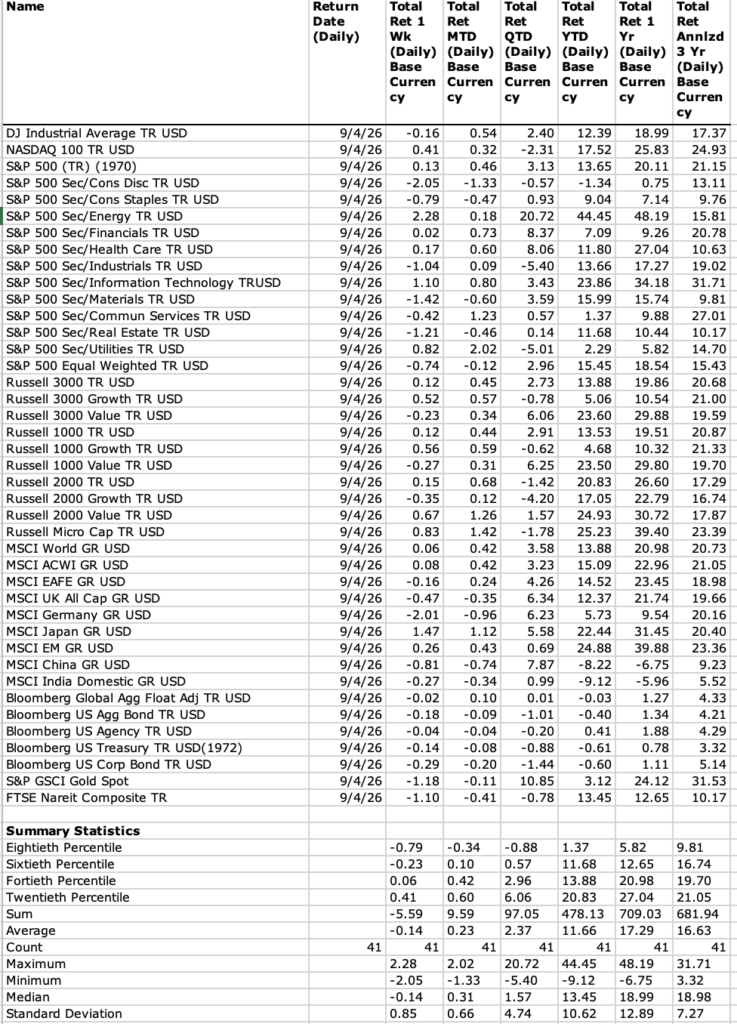
Source: Morningstar. Market data as of September 4, 2026. Past performance is not indicative of future results. The information provided is for educational and informational purposes only and does not constitute investment advice.