
Looking Ahead This Week: September 14, 2026
The Federal Open Market Committee convenes Tuesday and Wednesday for what is now one of the most consequential meetings of Chair Warsh’s tenure. The decision framework could scarcely be more complex: a labor market that rebounded sharply in August after two months of near-zero or negative payroll growth, a 10-year Treasury yield that breached the psychologically significant 5% threshold last week for the first time since the early tightening cycle, Brent crude surging back to $91 per barrel on renewed U.S.-Iran military activity, and a core CPI that delivered its most encouraging reading in years just two months ago at 2.5% annually. August CPI, released this morning before the FOMC enters its formal deliberations, will be the final piece of data the committee has in hand. A hotter-than-expected reading — made more likely by the energy price rebound — would almost certainly deliver the September hike that the three dissenting regional presidents have been arguing for since July.
The interest rate decision itself is only part of what markets will be watching. The updated Summary of Economic Projections — the dot plot — and Chair Warsh’s press conference will communicate the committee’s forward path with a degree of specificity that his Jackson Hole address deliberately avoided. Whether the September meeting produces a hike or a hold, the distribution of dots for year-end and 2027 will define the policy landscape for the rest of the year. A hike accompanied by language suggesting it is the last in the cycle would likely be received very differently than a hold accompanied by language explicitly preserving the option for further tightening. The Energy sector’s year-to-date return has now reached +47.43%, reflecting a geopolitical reality — sustained disruption of Strait of Hormuz flows — that the Fed cannot control but cannot ignore.
Economic Data and Market Highlights: Week of September 8, 2026
Macro Backdrop
The week of September 8 delivered a jarring combination of surging Treasury yields, renewed geopolitical escalation in the Middle East, and a broad-based equity selloff that reflected genuine uncertainty about the Federal Reserve’s imminent decision. The 10-year Treasury yield rose nearly 20 basis points over the course of the week to trade just below 5% — a psychologically significant threshold not breached since the early stages of the tightening cycle — as the market absorbed a confluence of inflationary signals that made the September hike case substantially harder to dismiss. Crude oil prices surged approximately 10% for the week to $91 per barrel, the highest level in months, as renewed U.S.-Iran military activity around the Strait of Hormuz — a sharp escalation from the diplomatic stalemate of recent weeks — removed the tentative optimism that the Oman-mediated safe-passage framework might soon provide relief. The renewed conflict dynamic upended the Hormuz reopening timeline once more, keeping global oil supply constrained and providing fresh ammunition for the committee’s hawkish wing.
The FOMC blackout period was already in effect as the week’s events unfolded, preventing Fed officials from responding publicly to the data. Markets were left to price the September decision themselves: futures markets shifted meaningfully toward assigning a greater probability to a hike, with Chair Warsh’s Jackson Hole remarks — that the Fed may have “work to do” and that 2% PCE is a “firm, fixed target” — taking on renewed resonance against a backdrop of $91 crude and a 10-year yield approaching 5%. The August jobs rebound of +162,000, fresh in investors’ minds from the prior Friday, completed the picture of a labor market that could sustain a rate increase. The question heading into Tuesday’s meeting is not whether the data justifies a hike — it does — but whether the Fed will look through the energy-driven component of renewed inflation pressure or treat the totality of the picture as requiring action.
Domestic Equities
The S&P 500 fell -0.78% for the week, with the equal-weighted index declining a more severe -1.89% that captured the breadth of the selling pressure across the market. Health Care was the week’s most dramatic underperformer, declining -3.54% — giving back a significant portion of August’s extraordinary +10% monthly gain — as two converging forces weighed on the sector simultaneously. The primary fundamental catalyst was renewed attention to the administration’s Most-Favored-Nation drug pricing policy, which proposes to benchmark U.S. pharmaceutical prices against lower international rates. Analysts estimate the policy, if fully implemented, could reduce large-cap pharma earnings by 9-10% over several years, representing a meaningful and underappreciated headwind for companies including Eli Lilly, Pfizer, and others whose domestic pricing power has been a cornerstone of their profitability. The secondary pressure came from rising interest rates: smaller biotechs and high-growth health care names are acutely sensitive to the discount rate environment, and the 10-year’s march toward 5% hit the sector’s longer-duration cash flows with particular force.
Energy was the week’s lone standout, gaining +2.06% as Brent crude’s return to $91 per barrel delivered another leg higher for a sector that has now generated +47.43% year-to-date — a return that stands in a category of its own among all major asset classes in 2026. Materials fell -2.70%, Industrials -1.64%, and Financials -1.50%, as the renewed yield surge and uncertain policy outlook weighed broadly on cyclical sectors. The Industrials sector’s quarter-to-date loss has now reached -6.95%, one of the most significant quarterly drawdowns for the sector since the pandemic, reflecting the compounding effects of elevated borrowing costs and growing questions about capital expenditure appetite in an economy that may be approaching a rate decision inflection point. Communication Services was the only other positive sector at +1.06%, while Information Technology was essentially flat at -0.17%, holding up considerably better than the broad market as large-cap technology’s AI narrative provided an offsetting floor.
International Equities
International markets broadly declined, with MSCI EAFE falling -1.38% for the week as dollar strength — a natural byproduct of the U.S. yield surge and associated hawkish repricing — weighed on international returns for dollar-based investors. MSCI Germany fell -2.00%, continuing a difficult September as the combination of elevated European energy prices from the renewed Hormuz escalation and a stronger dollar created a particularly adverse environment for Germany’s export-oriented industrial economy. MSCI UK All Cap declined -1.64%, while MSCI Japan was essentially flat at +0.06%, a relative outperformance that reflects the yen’s continued weakness against the dollar — which mechanically benefits Japanese export-sector earnings — and the structural resilience of Japan’s domestic reform story. MSCI Japan’s year-to-date return of +22.51% remains one of the more impressive performances among major developed markets.
Emerging markets declined modestly at -0.23% (MSCI EM), with significant divergences beneath the surface. MSCI China fell -2.91% — pushing its year-to-date return to -10.89% — as renewed Middle East military activity amplified China’s energy import cost pressures and sentiment toward Chinese assets deteriorated further. MSCI India Domestic declined -2.77% for the week and is now -11.64% year-to-date, marking it as one of the worst-performing major markets of 2026 — a striking contrast to its pre-conflict standing as one of the world’s most favored growth destinations. India’s energy import dependence through the Strait of Hormuz, combined with currency weakness and persistent domestic inflationary pressure, has created a particularly difficult multi-month environment for the country’s equity market. The broader EM universe’s +24.60% year-to-date return, anchored by commodity-export economies, continues to mask the heterogeneous reality beneath the headline.
Fixed Income
Fixed income markets suffered their worst weekly performance in months as the 10-year Treasury yield surged nearly 20 basis points to test the psychologically significant 5% level. The Bloomberg US Aggregate Bond Index fell -1.04% for the week — one of its largest single-week declines of the year — with U.S. Treasuries dropping -0.93% and corporate bonds falling -0.93% as well. The yield move reflected a toxic combination of inputs: a strong August jobs report still fresh in investor memory, crude oil surging to $91 per barrel on renewed geopolitical escalation, and the approaching September FOMC meeting with its attendant uncertainty about whether the committee will deliver its first rate hike in this cycle’s current phase. The Bloomberg US Aggregate Bond Index’s year-to-date return has deteriorated to -1.43% and its quarter-to-date loss has reached -2.04% — a painful reversal of the brief recovery achieved in August following the July jobs shock.
The 10-year Treasury yield approaching 5% carries significance beyond the number itself. At that level, Treasuries begin to represent genuinely competitive alternatives to equity risk premiums across a broader range of asset classes, and the economic impact of mortgage rates, corporate borrowing costs, and consumer credit begins to compound in ways that historically have preceded meaningful economic slowdowns. The September FOMC decision — hike or hold — will likely determine whether the 10-year consolidates below 5% or breaks through to levels not seen in a generation. The Bloomberg Global Aggregate Float Adjusted index fell -0.83% for the week, with international sovereign bond markets broadly moving in sympathy with the U.S. yield surge, reflecting the degree to which global rate expectations are now anchored by the Federal Reserve’s posture.
Alternatives & Commodities
Gold declined -1.51% for the week as the surging dollar and rising real yields — both mechanical consequences of the hawkish repricing following the strong August jobs report and renewed energy price pressure — weighed on the metal’s near-term appeal. Gold’s year-to-date return has retreated to +1.56%, a significant decline from the +7.82% peak reached in August, though the metal retains its quarter-to-date gain of +9.17% — a testament to the safe-haven surge that accompanied July’s labor market shock and the subsequent Hormuz re-escalation. The September FOMC decision will be a pivotal moment for gold: a hike that successfully contains the inflation narrative while not triggering recession fears would likely pressure the metal further; a hold that signals the Fed is acknowledging the economic risks of further tightening could provide meaningful support.
Energy’s +2.06% weekly advance — extending its year-to-date return to +47.43% — was driven by crude oil’s surge to $91 per barrel on the back of renewed U.S.-Iran military activity that cast fresh doubt over the Strait of Hormuz reopening timeline. Each successive disruption event in the waterway has reinforced what is now one of 2026’s most durable market themes: the Strait’s physical constraints represent a structural supply shock that responds to diplomacy at a very different pace than financial markets would prefer. The Energy sector has now generated more than triple the S&P 500’s year-to-date return, a divergence that quantifies the investment consequence of what has been the defining geopolitical event of the year. Real estate investment trusts (FTSE NAREIT Composite) fell -1.20% for the week and are now -1.96% quarter-to-date, as the 10-year yield’s approach to 5% represents the kind of rate environment in which real estate valuations face sustained compression.
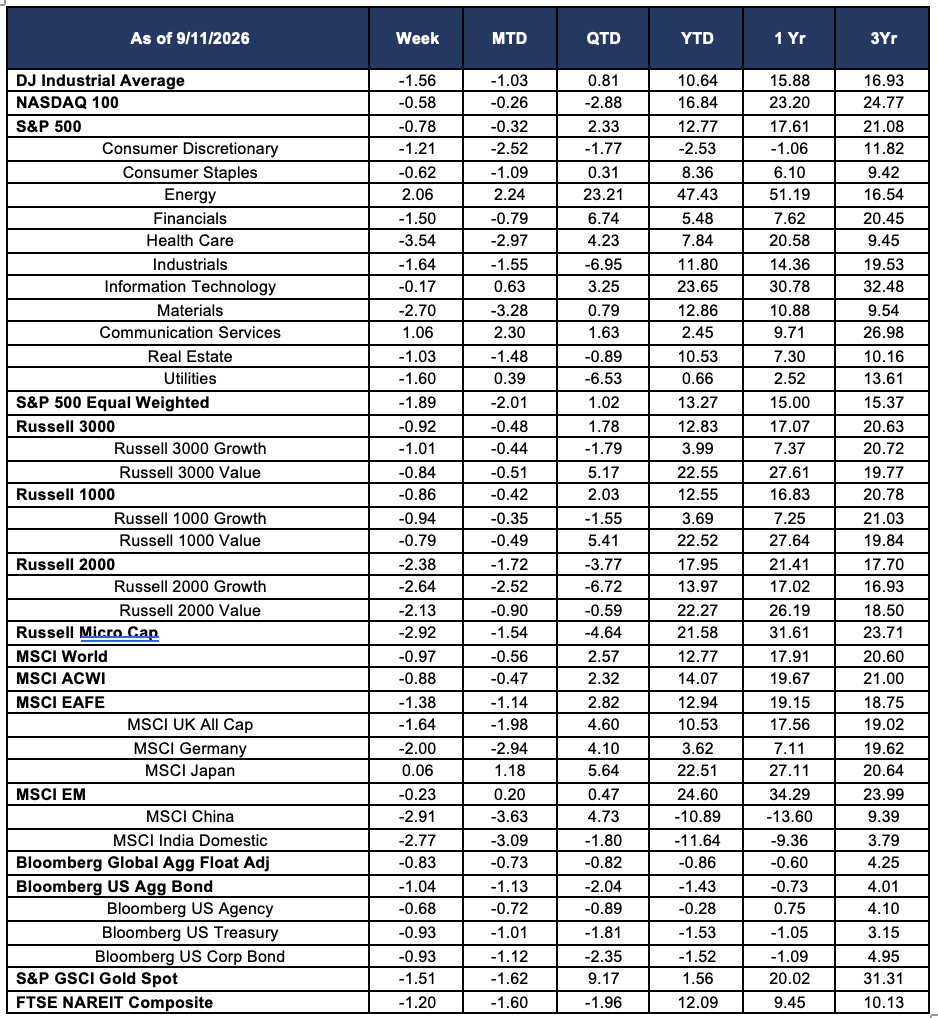
Source: Morningstar. Market data as of September 11, 2026. Past performance is not indicative of future results. The information provided is for educational and informational purposes only and does not constitute investment advice.