
Looking Ahead This Week: November 16, 2026
The AI trade faces its most consequential test of the quarter this week. Nvidia reports fiscal third-quarter results on Tuesday after the close, just five days after the company announced the immediate resignation of co-founder Jensen Huang as CEO. Chief Financial Officer Colette Kress is serving as interim CEO while the board conducts a search for a permanent successor, and the company has said it expects operations, customer commitments, and its product roadmap to continue without interruption. Analysts expect revenue of roughly $109 billion and earnings growth of about 90%, but guidance and management’s commentary on demand will likely matter more than the headline numbers. Nvidia shares fell -12.75% last week, and the company’s market value has declined from roughly $5.8 trillion in early October to about $3.9 trillion. Later in the week, Anthropic is expected to price its initial public offering on Wednesday, with trading likely to begin Thursday. The proposed range of $70–$78 per share would raise up to $64.4 billion and value the company at roughly $1.4 trillion at the top of the range, making it a direct read on investor appetite for AI at a moment of heightened skepticism.
The macro calendar is also full. Fed Chair Warsh speaks Monday, Governor Waller speaks Tuesday and Friday, and the minutes of the October 27–28 FOMC meeting are released Wednesday. Futures markets now fully price a rate increase at the December 8–9 meeting, and the debate has shifted to its size: CME FedWatch data last week showed roughly an 11% probability of a half-point move. October retail sales and industrial production are released Tuesday, housing starts Wednesday, and jobless claims and the Philadelphia Fed manufacturing survey Thursday. Retail earnings offer a timely read on the consumer as higher inflation outpaces wage growth: Home Depot and Disney report Tuesday, Target, Lowe’s, and TJX Wednesday, and Walmart Thursday morning. With the 10-year Treasury yield above 5.1% and Information Technology still -11.52% for the quarter, this week’s combination of Nvidia, the Anthropic offering, and Fed communication is likely to determine whether last week’s equity rebound can hold.
Economic Data and Market Highlights: Week of November 9, 2026
Macro Backdrop
October inflation came in hotter than expected, and the Federal Reserve’s response quickly shifted from whether to hike in December to how much. The Consumer Price Index rose 0.4% in October, above forecasts, while core CPI rose 0.3% for the third consecutive month. The pressure was not confined to energy: gasoline rose 1% on the month, but food, vehicle insurance, hospital services, and other service categories also moved higher. The Bureau of Labor Statistics did not publish most year-over-year figures because October 2025 data was not collected during last year’s government shutdown, though estimates put headline inflation near 4%. Producer prices rose 0.3% in October, slightly below expectations, but were up 6.5% year-over-year, the largest 12-month increase since November 2022, with core PPI up 4.9%.
Fed officials left little doubt about their direction. Governor Christopher Waller said he would support a quarter-point hike in December even if inflation had improved, and that a core CPI reading of 0.3% or more should put a half-point increase on the table, adding that “hiking only 25 basis points would put our credibility at risk.” Dallas Fed President Lorie Logan said the committee needs at least two more quarter-point increases. Futures markets moved to fully price a December hike, with CME FedWatch data showing roughly an 89% probability of a quarter-point move and 11% for a half-point move. Treasury yields rose sharply across the curve: the 2-year yield climbed roughly 37 basis points to 4.88%, and the 10-year yield rose about 30 basis points to 5.15%, touching 5.17% intraday on Friday, its highest level since October. The U.S. Dollar Index gained roughly 1% to 103.4, near its strongest level in 19 months.
Corporate news was dominated by Nvidia. On November 12, the company announced that Jensen Huang had resigned as President, CEO, and board member, effective immediately, without giving a reason. Colette Kress was named interim CEO, and former Synopsys CEO Harvey C. Jones became the company’s first Chair of the Board. Nvidia’s market value fell below $4 trillion on Friday. Elsewhere in AI, results were mixed: CoreWeave rose roughly 24% on Wednesday following its results, and Cerebras gained after reporting a surprise third-quarter profit, while Cisco and Applied Materials both declined despite beating estimates. In energy markets, Brent crude eased roughly 2% for the week to about $96 per barrel. Iran’s Revolutionary Guards said on Friday that two tankers struck mines in the Strait of Hormuz while crossing without authorization, a reminder that the strait remains contested even as U.S.-Iran talks continue.
Domestic Equities
Equities rallied despite the inflation surprise and the sharp rise in yields. The S&P 500 gained +2.54% for the week, snapping a four-week losing streak, and the Dow Jones Industrial Average rose +2.12%. The S&P 500 is now -1.07% for the quarter and +11.54% year-to-date. All eleven S&P 500 sectors finished higher. Energy led with a gain of +5.14%, recovering part of the prior week’s decline and bringing its year-to-date return to +48.16%. Industrials gained +3.71% and Communication Services +3.55%, followed by Consumer Staples (+2.67%), Consumer Discretionary (+2.65%), and Financials (+2.63%). Information Technology gained +2.00%, a modest rebound given Nvidia’s double-digit decline, leaving the sector -11.52% for the quarter. Real Estate (+0.97%) and Materials (+0.40%) lagged, with REITs held back by the rise in yields.
For the first time in four weeks, the cap-weighted S&P 500 edged ahead of the S&P 500 Equal Weighted index, which gained +2.37%, as semiconductor stocks outside of Nvidia rebounded strongly. Quarter-to-date, however, the equal-weighted index remains well ahead at +6.37% against -1.07% for the S&P 500. In style, Russell 1000 Growth (+2.83%) outperformed Russell 1000 Value (+2.29%) for the week, but the year-to-date gap remains near historic extremes, with Russell 1000 Value at +26.71% and Russell 1000 Growth at -2.46%. Small caps lagged the rally, with the Russell 2000 gaining +1.35%, led by Russell 2000 Growth (+1.83%) over Russell 2000 Value (+0.89%), while the Russell Micro Cap rose just +0.41%. Higher borrowing costs are a greater headwind for smaller companies, which rely more heavily on floating-rate debt. The broader Russell 3000 gained +2.48% and is +11.58% year-to-date.
International Equities
International developed markets participated in the rally, with MSCI EAFE gaining +2.07%. MSCI Japan led with a gain of +5.18%, recovering a significant portion of the prior week’s -7.48% decline as Japanese semiconductor equipment makers rebounded, though the market remains -6.74% for the quarter. MSCI Germany gained +2.26%, and MSCI UK All Cap rose +1.11%. MSCI World advanced +2.40% and MSCI ACWI +2.49%. The stronger dollar was a headwind for U.S.-based investors in overseas markets, with the euro weakening to around $1.10.
Emerging markets gained +3.21% (MSCI EM), though the asset class remains -8.95% for the quarter. China was the clear exception. MSCI China fell -4.63%, giving back most of the prior week’s rebound, as Hong Kong-listed technology shares sold off on renewed concerns about AI valuations; the Hang Seng Tech index fell 3% on Friday alone. MSCI China is now -17.51% year-to-date and -23.00% over the trailing year. MSCI India Domestic added +0.57%, holding its gains from the prior week’s sharp rally; the index is +9.61% month-to-date and +11.03% for the quarter, though still -5.63% for the year.
Fixed Income
Fixed income ended its five-week winning streak with a sharp decline, as the hot inflation data and hawkish Fed commentary pushed yields higher across the curve. The Bloomberg US Aggregate Bond Index fell -1.50% for the week, and Bloomberg US Treasuries declined -1.45%. The Aggregate has given back roughly half of its quarter-to-date gain, which now stands at +1.31%, and its year-to-date return has fallen to -1.64%. Bloomberg US Corporate Bonds declined -1.35%, bringing their year-to-date return to -1.96%, while the Bloomberg US Agency index fell -1.01%. The Bloomberg Global Aggregate Float Adjusted index declined -1.43%, with the stronger dollar adding to losses for unhedged global bonds.
The week marked a meaningful shift in the rate outlook. The rise in the 2-year yield, the most policy-sensitive part of the curve, reflects a market that now views the Fed as having further to go, with some officials openly discussing a half-point move in December. Wednesday’s release of the October FOMC minutes and Fed officials’ remarks throughout the week will be closely watched for signals about the size of the December hike. Despite the week’s losses, starting yields above 5% on the 10-year Treasury offer the most attractive income opportunity in nearly two decades for investors with a longer time horizon, and high-quality bonds continue to provide meaningful diversification against equity market risk.
Alternatives & Commodities
Gold fell -4.00% for the week, giving back nearly all of the prior week’s gain and extending its year-to-date loss to -9.74%. The metal faced the classic headwinds for a non-yielding asset: a sharp rise in real yields, a stronger dollar, and growing expectations that the Fed may need to tighten more aggressively than previously expected. Gold futures ended the week near $3,886 per ounce.
Energy rebounded +5.14% for the week, recovering part of the prior week’s decline even as Brent crude eased about 2% to roughly $96 per barrel. The sector’s year-to-date return of +48.16% remains the strongest of any S&P 500 sector. Friday’s reported mine strikes on tankers in the Strait of Hormuz underscore that supply risk remains elevated while U.S.-Iran negotiations continue. Real estate investment trusts (FTSE NAREIT Composite) gained a modest +0.67% for the week and are +14.57% year-to-date, with the sharp rise in Treasury yields limiting their participation in the broader equity rally.
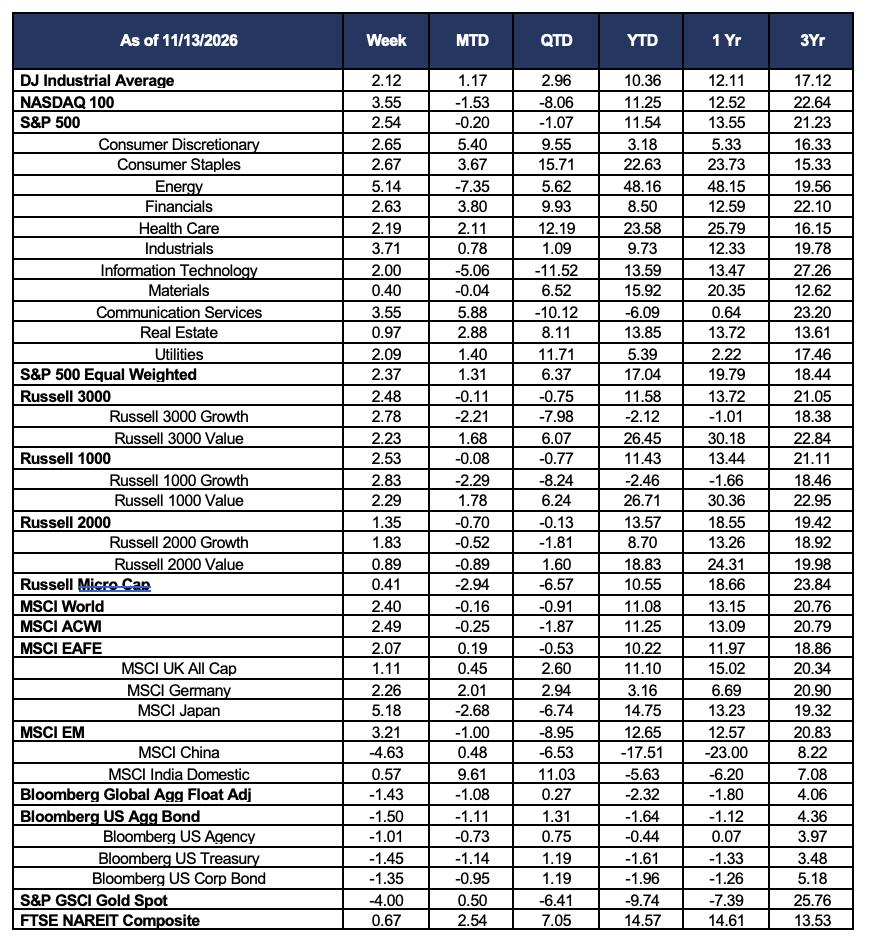
Source: Morningstar. Market data as of November 13, 2026. Past performance is not indicative of future results. The information provided is for educational and informational purposes only and does not constitute investment advice.