
Looking Ahead This Week: July 27, 2026
The Federal Reserve’s July 28-29 FOMC meeting opens the week against a backdrop of competing signals: softer labor market data and a meaningfully lower headline CPI argue for continued patience, while surging Treasury yields — the 10-year hit a year-to-date high of approximately 4.7% on Thursday — and persistently elevated energy prices complicate any dovish pivot. Markets expect Chair Warsh to hold rates at 3.50-3.75%, but the statement language and press conference tone will be scrutinized closely for any moderation of the June dot plot’s tightening bias. A measured, data-dependent message could stabilize rate-sensitive assets; any hint of renewed hawkishness risks accelerating the bond market’s recent selloff.
Earnings season reaches its most consequential stretch this week. Meta reports Tuesday ahead of the FOMC decision — the stock has fallen nearly 10% year-to-date and investors will be watching AI monetization progress closely after Alphabet’s capex-driven selloff. Amazon reports Thursday, providing a critical read on consumer health, cloud infrastructure demand, and AI-driven advertising. Apple reports the following week. The pattern of Q2 earnings so far — strong revenue, strong cloud growth, but aggressive capex guidance triggering stock declines — will be tested again as investors assess whether the AI spending cycle is generating returns commensurate with its cost.
Economic Data and Market Highlights: Week of July 21, 2026
Macro Backdrop
The week of July 21 was defined by two mega-cap earnings disappointments that erased hundreds of billions of dollars in market capitalization in a single session, compounded by a simultaneous surge in Treasury yields to year-to-date highs. Tesla reported second-quarter earnings on July 22 that missed consensus EPS estimates by approximately 38%, with per-share profit of $0.33 against expectations of $0.55. Auto gross margins contracted by more than two percentage points to 16.9%, free cash flow turned negative for the first time since early 2024, and the company reaffirmed plans to spend more than $25 billion on capital expenditures in 2026 — a tripling of its prior-year capex. Tesla shares fell approximately 14% on July 23, shedding more than $140 billion in market capitalization.
Alphabet reported the same evening, delivering Q2 revenue growth of 24% year-over-year to $119.8 billion with Google Cloud revenue surging 82% — a genuinely exceptional result. Yet the stock fell sharply as investors focused on the company’s substantial increase in 2026 capital expenditure guidance, reinforcing a market-wide concern that the AI infrastructure buildout is consuming enormous capital with uncertain near-term returns. The pattern — strong revenue beats undermined by aggressive AI capex announcements — has now recurred across Nvidia, Dell, TSMC, Broadcom, and Alphabet, suggesting that the market has decisively shifted from rewarding AI growth to demanding AI profitability.
Domestic Equities
The two earnings disappointments devastated their respective sectors. Consumer Discretionary fell -6.09% for the week, entirely driven by Tesla’s collapse — the electric vehicle maker carries enormous weight in the sector index, and its 14% decline was sufficient to overwhelm modest gains elsewhere in the sector. Communication Services fell -6.15%, led by Alphabet’s post-earnings drop and sympathy selling across the platform technology complex. The two sectors together erased the equivalent of a significant portion of the S&P 500’s year-to-date gains in a single session. Consumer Discretionary is now -7.63% year-to-date and Communication Services -3.78% YTD, two of only three sectors in negative territory for 2026.
Crucially, the broader market held up considerably better than the headline numbers suggest. The equal-weighted S&P 500 finished the week essentially flat at +0.08%, confirming once again that the selloff is concentrated in a narrow band of mega-cap names rather than reflecting systemic economic weakness. Energy continued its remarkable run, surging +3.76% for the week and extending its year-to-date lead to +34.95% — the best-performing S&P 500 sector in 2026 by an extraordinary margin. Industrials (+1.77%), Materials (+1.24%), and Utilities (+2.48%) all posted solid gains, supported by the same value rotation that has characterized much of the second quarter. The Russell 1000 Growth index has now turned negative on the year at -0.25% YTD, a remarkable reversal from its first-quarter highs, while Russell 1000 Value remains up +19.00% YTD.
International Equities
International markets were comparatively resilient, with MSCI EAFE posting a modest gain of +0.45% for the week. MSCI Japan recovered +1.71% following its prior week’s sharp decline, as semiconductor-related selling moderated and yen dynamics provided less headwind to exporters. MSCI UK All Cap gained +0.45%, while MSCI Germany was essentially flat at +0.14%, navigating a challenging backdrop of weak domestic growth and global tech sector uncertainty.
Emerging markets edged up +0.49% (MSCI EM), though MSCI India Domestic fell -2.16% on continued pressure from elevated energy import costs and currency weakness, bringing its year-to-date return to -11.98%. MSCI China continued its incremental recovery, gaining +0.86% on the week. The broader EM asset class remains up +17.49% year-to-date despite the recent turbulence, though the QTD figure of -5.27% reflects the challenging July environment driven by rising U.S. yields and dollar strength. The divergence between EM’s strong year-to-date position and its difficult recent weeks illustrates how quickly global risk appetite can shift when U.S. rates and growth narratives are in flux.
Fixed Income
The bond market suffered its worst week in several months as Treasury yields surged to year-to-date highs. The 10-year Treasury yield reached approximately 4.7% — its highest level of 2026 — while 30-year rates touched 5.19%, approaching multi-decade highs. The yield surge was driven by the confluence of rising oil prices that reignited inflation expectations, a heavy Treasury supply calendar, and the 2-month T-bill yield spiking 13 basis points as markets re-examined the probability of a rate hike at the July 28-29 FOMC meeting. The Bloomberg US Aggregate Bond Index fell -0.74% for the week, pushing year-to-date returns to -0.57%. Bloomberg US Corporate Bond dropped -0.92%, the worst weekly performance for investment-grade credit since the spring inflation shock.
The fixed income outlook has deteriorated at the margin from the optimism that followed the June CPI report. While the inflation trend is improving — headline CPI at 3.5% YoY is a meaningful step toward target — the combination of rising energy prices from Strait of Hormuz reopening delays, elevated Treasury supply, and an uncertain Fed policy path has renewed pressure on duration assets. The upcoming FOMC meeting is critical for fixed income: a genuinely measured hold with softer language on future tightening could provide meaningful relief for the bond market, while any hawkish surprise risks extending the yield surge and compressing bond prices further.
Alternatives & Commodities
Gold recovered +1.32% for the week, finding some demand as a haven asset amid the equity market volatility and rising long-term yields. The metal remains -4.87% year-to-date, but the pattern of modestly positive weeks amid turbulent equity conditions suggests some underlying floor in safe-haven demand. Whether gold can mount a more sustained recovery depends on the trajectory of real yields: if the FOMC softens its tone and the inflation trend continues to moderate, falling real yields would be a genuine positive catalyst for the metal.
Energy’s +3.76% weekly advance brought the sector’s third-quarter gain to +12.78% in just three and a half weeks — an extraordinary pace reflecting the persistent complications in physically reopening the Strait of Hormuz and the associated supply constraints in global crude markets. The Energy sector’s year-to-date return of +34.95% stands alone at the top of all S&P 500 sectors by a wide margin, a testament to how deeply the conflict and its aftermath have reshaped the energy landscape of 2026. Real estate investment trusts (FTSE NAREIT Composite) gained +0.93% despite the significant rise in Treasury yields, a sign of the resilience built up through the sector’s strong year-to-date performance of +19.64%.
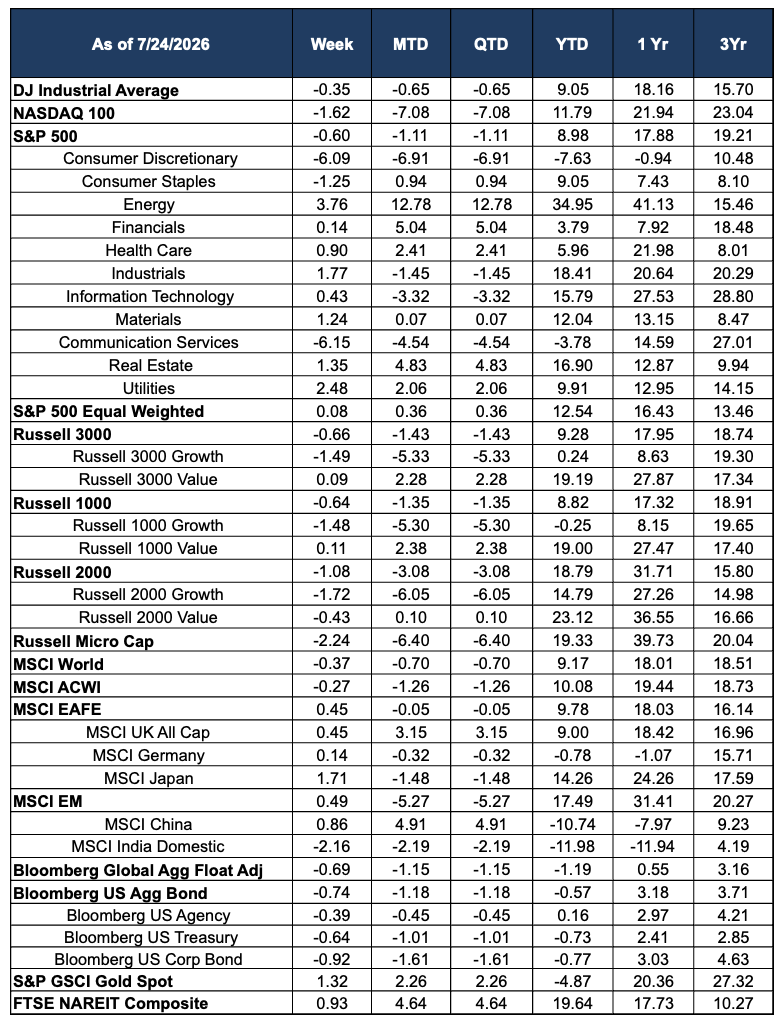
Source: Morningstar. Market data as of July 24, 2026. Past performance is not indicative of future results. The information provided is for educational and informational purposes only and does not constitute investment advice.