
Looking Ahead This Week: July 20, 2026
With June CPI printing below expectations and rate-hike odds collapsing from over 40% to below 17% in a single session, the Federal Reserve’s July 28-29 FOMC meeting is shaping up to be one of the more consequential of Chair Warsh’s tenure. Markets will be watching for any softening of the hawkish dot plot language from June — particularly given the simultaneous softening of both inflation (3.5% headline CPI) and the labor market (57,000 June payrolls). A hold with a notably less restrictive tone could be the catalyst needed to stabilize the growth and technology sectors, which have now endured a punishing multi-week decline.
Earnings season accelerates this week, with major technology names reporting alongside consumer and industrial bellwethers. The semiconductor complex will be under particular scrutiny after the global chip selloff — triggered in part by TSMC’s earnings beat that nonetheless saw the stock fall more than 4% on AI capex sustainability concerns — raised questions about the near-term demand trajectory for AI hardware. Netflix, Tesla, and a range of large-cap industrials and consumer discretionary names report throughout the week. The interplay between softer macro data, a more measured Fed, and corporate earnings results will define the character of the equity market in Q3.
Economic Data and Market Highlights: Week of July 14, 2026
Macro Backdrop
The week’s defining macro event arrived Tuesday morning in an unusually consequential double print: June CPI and Q2 bank earnings landed simultaneously before the market open on July 14. The inflation report was the more market-moving of the two. Headline CPI fell 0.4% for the month, pulling the year-over-year rate from 4.2% to 3.5% — below the 3.9% consensus estimate and the sharpest monthly deceleration in headline inflation since the early stages of the pandemic. The driver was unmistakable: gasoline prices fell nearly 10% in June, the direct mechanical consequence of the Iran ceasefire and the gradual reopening of the Strait of Hormuz. Core CPI, stripping out food and energy, held at 2.9% annually — still above target but no longer accelerating. The rate-hike probability for the July FOMC meeting collapsed from approximately 42% the prior day to roughly 16-17% in the immediate aftermath of the release.
The policy implication is significant: the June CPI report, combined with the prior week’s dramatically weak June payrolls print of 57,000, has sharply altered the calculus for the July 28-29 FOMC meeting. What was shaping up as a potentially live discussion of rate hikes is now expected to produce an unambiguous hold — and markets will be watching Chair Warsh’s tone for any indication that the tightening bias is moderating. Despite the positive inflation news, equity markets remained under pressure for much of the week as a global semiconductor selloff, sparked by earnings-related concerns in Asia, overwhelmed the relief from the CPI data.
Domestic Equities
The S&P 500 fell -1.55% for the week as technology and growth stocks declined sharply for what is now a fifth consecutive difficult week. Information Technology dropped -3.78% and the NASDAQ 100 tumbled -4.13%, extending year-to-date losses that have now erased much of the sector’s spectacular first-quarter gains. The pain in semiconductors was global and acute: TSMC reported a 77% year-over-year profit surge on July 16 — a genuinely extraordinary result — yet its stock fell more than 4% as investors questioned whether the current pace of AI infrastructure capital expenditure is sustainable beyond 2026. The concern rippled through the SOX index and spread globally, accelerating the technology sector’s retreat. Communication Services fell -2.38%, adding to the sector’s recent underperformance.
The rotation dynamic continued to favor value and defensives over growth. Russell 1000 Value gained +0.45% while Russell 1000 Growth fell -3.64% — a spread of over 4 percentage points in a single week. Energy was by far the week’s top-performing sector, surging +4.99% as complications in the physical reopening of the Strait of Hormuz — mines, vessel inspections, and insurer confidence — kept crude supply constrained and oil prices firmer than expected. Real Estate rose +2.28% and Consumer Staples gained +1.40% as the softer CPI reading lowered real yields and restored appetite for income-producing and defensive assets. The equal-weighted S&P 500 fell only -0.41%, again illustrating that the market’s headline decline is concentrated in a narrow band of mega-cap technology names rather than reflecting broad economic deterioration.
International Equities
The global semiconductor selloff hit international markets hard, with MSCI Japan bearing the brunt of the damage. The Nikkei 225 fell 6.4% for the week — one of its worst weekly performances of 2026 — as the contagion from the U.S. chip complex selloff combined with a strengthening yen to create a severe headwind for Japan’s export-oriented technology sector. TSMC’s earnings-related decline prompted broad selling in Asian semiconductor names including South Korean memory chipmakers, amplifying volatility across the region. MSCI Japan fell -4.09% for the week. MSCI Germany also retreated -0.70%, while the broader MSCI EAFE managed a modest +0.44% gain, supported by MSCI UK All Cap’s +1.44% advance as the UK’s less technology-heavy index composition provided relative shelter.
Emerging markets declined -0.65% (MSCI EM), though once again China was a notable positive outlier. MSCI China gained +2.47% for the week, extending its recent recovery, as domestic policy support measures and improving sentiment around Chinese consumer spending provided a counterpoint to the broader global tech selloff. The divergence between China (+7.27% month-to-date) and the broader EM index (-3.21% MTD) reflects the degree to which emerging market performance in July has been driven by China-specific factors rather than global macro tailwinds. MSCI EM retains its year-to-date lead among major global equity regions at +20.04%, though the margin has narrowed from its peak.
Fixed Income
Fixed income markets benefited from the week’s dramatic CPI surprise, with the Bloomberg US Aggregate Bond Index gaining +0.13% as Treasury yields declined on the sharply lower-than-expected inflation reading. Bloomberg US Treasury rose +0.15% and Bloomberg US Agency gained +0.16%, as the immediate repricing of rate-hike odds provided a meaningful tailwind for duration assets. The reaction — while positive — was modest in magnitude, reflecting both the stickiness of core inflation at 2.9% and investor caution about fully pricing out the Fed’s tightening bias ahead of the July FOMC meeting.
The year-to-date picture for fixed income continues to improve incrementally: the Bloomberg US Aggregate Bond is up +0.16% for 2026, Treasuries are modestly negative at -0.09% YTD, and corporate bonds are roughly flat at +0.15% YTD. If the FOMC meeting on July 28-29 produces a measurably less hawkish tone — consistent with the CPI and payrolls data of recent weeks — fixed income could see a more sustained recovery in the second half of the year. The real test will be whether core inflation continues its gradual moderation or re-accelerates as shelter and services costs remain elevated.
Alternatives & Commodities
Gold continued to give ground, declining -1.78% for the week despite the softer CPI data that might normally support precious metal prices. The metal’s continued weakness likely reflects the improved risk tone early in the week following the CPI beat, as well as ongoing dollar firmness. Year-to-date, gold is now -6.11%, having completed a full reversal of its extraordinary early-2026 gains driven by the Iran war and peak geopolitical anxiety. The trailing twelve-month return of +19.83% still reflects the significant role gold played as a portfolio stabilizer during the height of the conflict.
The Energy sector’s +4.99% weekly advance reinforced that crude oil’s decline from its April highs has found a floor. Physical logistics — de-mining operations, vessel inspection requirements, and the time needed to restore full insurance market confidence — mean that the Strait of Hormuz will not return to full operational capacity for several more months. The Energy sector’s year-to-date return of +30.07% remains the best among all S&P 500 sectors in 2026 by a substantial margin. Real estate investment trusts (FTSE NAREIT Composite) gained +2.75%, responding favorably to the decline in real yields following the CPI surprise and extending their year-to-date return to +18.54%.
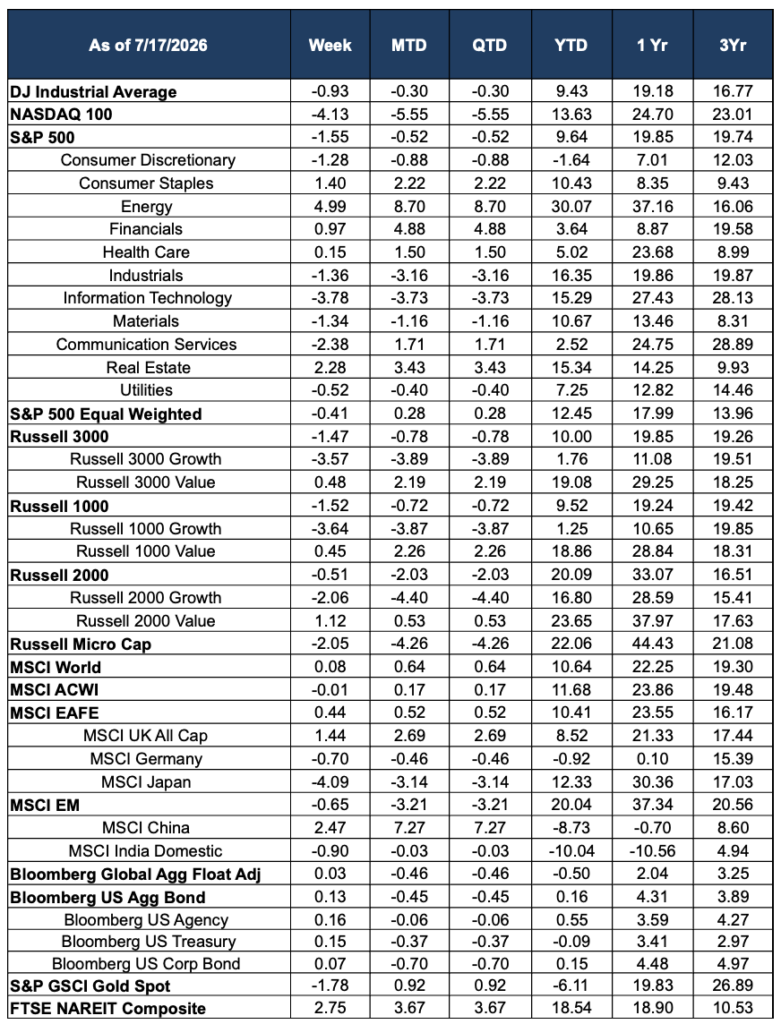
Source: Morningstar. Market data as of July 17, 2026. Past performance is not indicative of future results. The information provided is for educational and informational purposes only and does not constitute investment advice.