
Looking Ahead This Week: August 31, 2026
Markets open a shortened Labor Day week with the full weight of Chair Warsh’s Jackson Hole message to digest. His Friday remarks — asserting the Fed may have “work to do” on inflation and reaffirming 2% PCE as a “firm, fixed target” while deliberately refusing to commit to a September decision — landed somewhere between the hawkish outcome markets feared and the neutral pivot they hoped for. The absence of a pre-commitment to hiking is providing near-term support for growth assets, but Warsh’s unambiguous signal that summer inflation improvements have not yet convinced him that “underlying trends have meaningfully improved” puts the September FOMC meeting squarely back in play. The next three weeks of data will effectively serve as the deciding vote.
The August nonfarm payrolls report on Friday, September 4 is the week’s most consequential release. After two consecutive months of deeply negative or negligible payroll growth — July’s -23,000 and the revised June reading of only 20,000 — the August print will either confirm that the labor market has entered a genuine contraction or suggest that July’s shocking miss was an outlier driven by seasonal factors and government employment cuts. A third consecutive month of weakness would make a September rate hike politically and economically untenable even for the committee’s three hawkish dissenters. Conversely, a meaningful rebound toward 100,000 or more would reignite the September debate immediately. The week’s PCE inflation data for July, also due Thursday, will round out the picture with the Fed’s preferred inflation gauge.
Economic Data and Market Highlights: Week of August 25, 2026
Macro Backdrop
The week’s defining moment arrived Friday morning when Federal Reserve Chair Kevin Warsh delivered his first keynote address at the Kansas City Fed’s Jackson Hole Economic Policy Symposium — marking his 100th day in office with a speech that was more hawkish than the structural framing suggested but less directive than markets feared. Warsh told the assembled central bankers and economists that while summer inflation readings were better than expected, they do not tell him that underlying trends have meaningfully improved. He reaffirmed 2% as measured by the PCE price index as a “firm, fixed target,” and stated that the Fed may have “work to do” on inflation — language that explicitly preserves the option of rate hikes without committing to one. His governing principle, described as being “committed to a discipline, not to a decision,” encapsulated an approach to monetary policy communication that differs sharply from the forward guidance frameworks his predecessors favored.
The market’s initial reaction was measured and nuanced, consistent with a speech that delivered neither the hawkish commitment that the three July dissenters might have hoped for nor the dovish pivot that rate-sensitive sectors have been seeking all summer. With 30-year Treasury yields already hovering near 5.2% and the September meeting approximately three weeks away, Warsh’s deliberate ambiguity leaves the committee maximum optionality — but also maximum uncertainty for investors attempting to position ahead of the decision. The week’s price action across asset classes told a coherent story: assets that had overshot into safe-haven or defensive positioning corrected modestly, while sectors that benefit from the relief of a hike not yet being announced recovered ground.
Domestic Equities
The S&P 500 gained +0.50% for the week, with large-cap technology and communications stocks leading a rotation that reflects the market’s interpretation of the Jackson Hole speech as not pre-committing to a September hike. Information Technology advanced +1.80% — its second consecutive positive week — with the sector’s month-to-date gain now standing at +5.93%, a substantial recovery from July’s -3.43% monthly loss. Communication Services gained +1.57% and Financials rose +1.07%, as the prospect of rates remaining at current levels rather than rising further provided support for bank net interest margin and lending volume assumptions. The Russell 1000 Growth index nudged forward +0.31%, while Russell 1000 Value gained +0.40%, a relatively narrow weekly spread that suggests the great rotation of 2026 is entering a more balanced phase — at least temporarily — as policy uncertainty reduces conviction in either direction.
Small-cap and mid-cap indices underperformed meaningfully, underscoring that Warsh’s message was not interpreted as a full-throated endorsement of economic stability. The Russell 2000 fell -1.49% and Russell Micro Cap declined -1.62%, as smaller companies — more vulnerable to elevated borrowing costs and more exposed to domestic economic conditions — bore the cost of ongoing uncertainty about the Fed’s near-term path. Health Care gave back -1.95% following last week’s +4.33% surge, a normal consolidation after one of the sector’s best weeks of the year. Energy pulled back -1.96% and Industrials fell -1.72%, the latter’s quarter-to-date loss now reaching -4.41% — a meaningful underperformance that reflects the difficulty cyclical businesses face when the economic outlook is simultaneously clouded by a softening labor market and an unresolved energy supply shock. The equal-weighted S&P 500 declined -0.44%, confirming the week’s gains were concentrated in large-cap technology and communications rather than broadly distributed.
International Equities
International developed markets were broadly stable, with MSCI EAFE advancing a modest +0.11% for the week. MSCI Japan recovered +1.26% following its prior week’s -3.33% yen-driven selloff, as currency volatility stabilized and investors returned to a market that has generated exceptional returns year-to-date (+20.67% YTD). MSCI Germany gained +1.37%, continuing its strong August and extending its quarter-to-date return to +8.41%, one of the better performances among major developed markets in the third quarter. Germany’s outperformance in a period of continued Hormuz uncertainty likely reflects improving European energy supply from alternative sources and growing confidence in the durability of the ceasefire framework even as Iran’s specific demands remain unresolved.
Emerging markets were essentially flat for the week at +0.05% (MSCI EM), as MSCI China’s -1.13% decline offset modest gains elsewhere. China’s pullback extended its underperformance relative to the broader EM universe — the country is -7.47% year-to-date against the EM index’s +24.55% — though the quarter-to-date figure of +8.75% shows the extent to which domestic policy stimulus has driven a meaningful partial recovery from the first half’s losses. MSCI India Domestic was nearly flat at +0.14%, continuing to struggle with the year’s dual headwinds of elevated energy import costs and currency pressure; the index is -8.88% year-to-date. The broader EM asset class’s year-to-date leadership — driven by Southeast Asia, Latin America, and commodity-export-oriented economies — remains one of the more striking divergences from the conventional wisdom that entered 2026.
Fixed Income
Fixed income markets posted a modestly positive week, with the Bloomberg US Aggregate Bond Index gaining +0.13% as Warsh’s Jackson Hole speech, while hawkish in tone, did not deliver the yield-spiking pre-commitment to a September rate hike that the bond market’s more cautious participants had feared. Bloomberg US Treasuries gained +0.07% and investment-grade corporate bonds advanced +0.32%, the latter benefiting from tightening credit spreads as the risk environment improved marginally. The broader picture for fixed income remains challenging: the Bloomberg US Aggregate is -0.21% year-to-date and the QTD return of -0.83% reflects the persistent upward pressure on yields that has characterized the third quarter. The 30-year Treasury yield near 5.2% represents a historically elevated level that continues to serve as both a ceiling on fixed income valuations and a floor beneath which equity risk premiums are compressed.
August closes as one of the more remarkable months for fixed income in recent memory from a volatility perspective. The Bloomberg US Aggregate gained +0.48% MTD despite significant intra-month swings driven by the July jobs shock, successive Hormuz re-escalation oil price moves, the July CPI report, and Friday’s Jackson Hole speech. Looking into September, the path for fixed income will be determined largely by the August employment report (due Friday, September 4) and the August CPI release (mid-September), with the September FOMC meeting itself likely to be the inflection point for either a sustained bond recovery or a resumption of the yield pressure that has weighed on duration assets throughout 2026.
Alternatives & Commodities
Gold fell -3.22% for the week — its first weekly decline in three weeks — as Warsh’s Jackson Hole speech reinforced the Fed’s anti-inflation credibility and reduced the premium investors had assigned to scenarios involving a loss of Fed policy control. Despite the weekly pullback, gold’s August performance remains extraordinary: the metal gained +10.30% during the month, driven by the convergence of collapsing rate-hike expectations (following the July jobs report), Strait of Hormuz re-escalation, and the broader stagflation risk narrative. Gold’s year-to-date return of +4.35% now sits firmly in positive territory — a meaningful recovery from the -6.11% trough reached in mid-July — and the trailing twelve-month return of +30.38% captures the full arc of the metal’s 2026 journey from conflict-driven peak to summer selloff to partial recovery.
Energy declined -1.96% for the week in what appears to be a technical consolidation after its extraordinary summer run rather than a fundamental reversal. With the Strait of Hormuz still physically constrained and Iran’s diplomatic demands unresolved, the structural supply-side argument for elevated crude prices remains intact. The Energy sector’s year-to-date return of +41.23% — and its quarter-to-date gain of +18.03% — continue to stand without peer among major asset classes in 2026. Real estate investment trusts (FTSE NAREIT Composite) fell -1.21% for the week and are now -1.89% month-to-date, as Warsh’s hawkish-but-uncommitted message did little to loosen the grip of near 5.2% 30-year yields on the sector’s valuation. Year-to-date REITs remain in solid positive territory at +14.72%, reflecting the strong performance accumulated before the Fed’s summer tightening pivot.
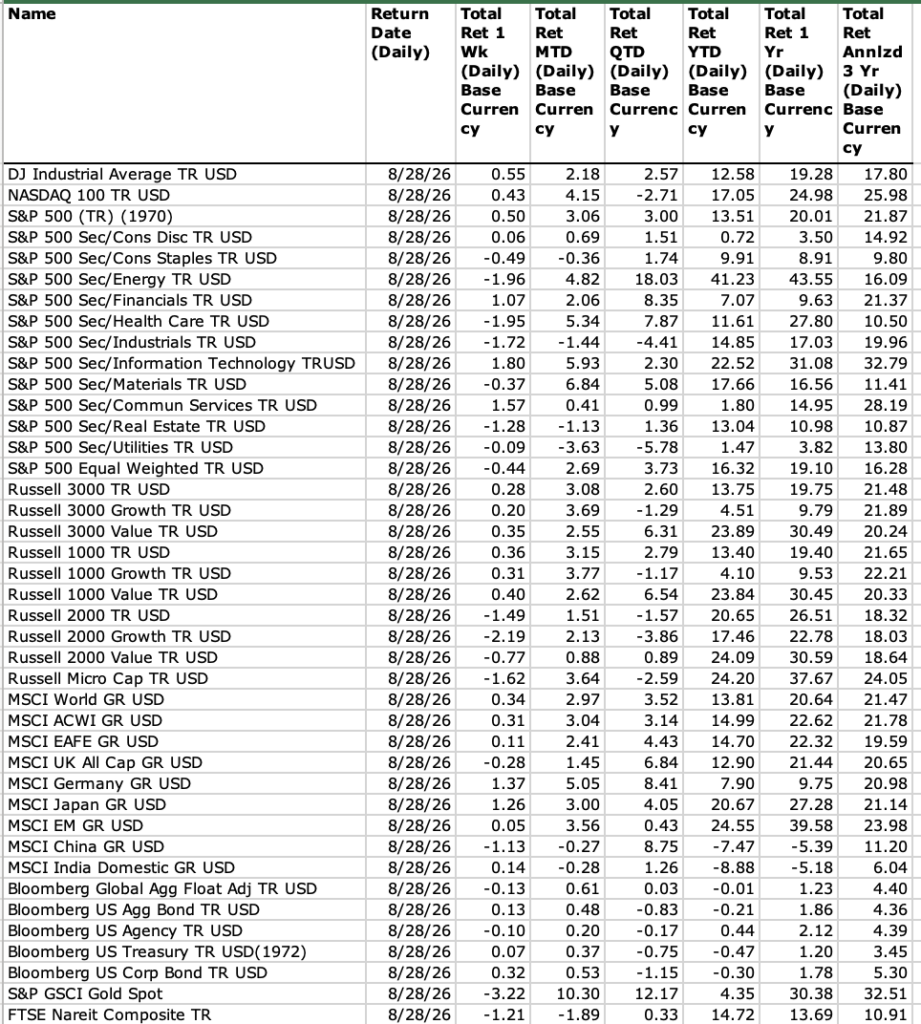
Source: Morningstar. Market data as of August 28, 2026. Past performance is not indicative of future results. The information provided is for educational and informational purposes only and does not constitute investment advice.