
Looking Ahead This Week: August 17, 2026
The Federal Reserve’s annual Jackson Hole Economic Symposium, scheduled for late August, is emerging as the most consequential policy communication moment since the July FOMC meeting. The accumulation of evidence in recent weeks — two consecutive months of deeply negative or near-zero payroll growth, a July CPI core rate of 2.5%, and a catastrophic July jobs print of -23,000 — has materially shifted the policy debate. September rate-hike odds have fallen to approximately 42% following last week’s CPI report, but Chair Warsh’s Jackson Hole remarks have the potential to move that figure dramatically in either direction. Any signal of a formal shift away from the tightening bias would likely trigger a significant rally in rate-sensitive assets; maintaining the current posture in the face of contracting employment would extend the uncertainty that has weighed on fixed income and growth equities throughout the summer.
The Strait of Hormuz remains the other dominant force shaping market dynamics this week. Iran’s escalation of demands — now including an end to U.S. military threats, a formal sanctions waiver, and financial compensation as conditions for reopening the waterway — has effectively reversed the optimism that accompanied the initial ceasefire. Brent crude ended last week at approximately $84.60 per barrel after surging more than 3% on Monday, and the trajectory of diplomatic talks will be watched closely by energy traders and equity investors alike. Any credible sign of diplomatic progress would meaningfully pressure the Energy sector, which has recovered to +39.94% year-to-date on renewed supply concerns. Retail sector earnings from Walmart and Target this week will provide the first read on whether the twin pressures of rising energy costs and a weakening labor market are yet translating into measurable consumer spending declines.
Economic Data and Market Highlights: Week of August 11, 2026
Macro Backdrop
The week’s macro narrative was shaped by the intersection of two countervailing forces. On Wednesday, August 12, the Bureau of Labor Statistics released the July Consumer Price Index, delivering a result that offered genuine incremental progress: headline CPI rose just 0.1% for the month, bringing the year-over-year rate down to 3.4% from 3.5% in June. Core CPI — excluding food and energy — rose 0.2% for the month and 2.5% annually, the lowest core reading since the early stages of the current tightening cycle and now within striking distance of the Fed’s long-term target. Shelter, which has been the most stubborn component of core inflation throughout 2026, rose only 0.1% — a meaningful deceleration that, if sustained, would remove one of the primary arguments for continued rate hikes. Stock futures rose and Treasury yields declined immediately following the release.
The relief from the CPI report was partially offset, however, by a sharp re-escalation in Strait of Hormuz tensions. Tehran formally presented a list of conditions for reopening the waterway that went well beyond the original ceasefire framework: demands included an end to U.S. military threats in the region, a formal waiver of energy-related sanctions, and financial compensation for economic losses sustained during the conflict. The announcement effectively reversed months of diplomatic progress and sent Brent crude surging more than 3% on the first trading day of the week, reaching $84.64 per barrel — levels not seen since the acute phase of the conflict. Markets were left navigating a complex combination of improving inflation data and renewed commodity supply shock, explaining the week’s unusual pattern of performance across asset classes.
Domestic Equities
The Energy sector dominated the weekly equity return landscape for the second time in three weeks, surging +7.33% as oil prices reclaimed their summer highs on the Hormuz re-escalation. The move extended the sector’s third-quarter gain to +16.95% and pushed its year-to-date return to +39.94% — approaching a level that would represent one of the best annual performances for any major S&P 500 sector in the past three decades. The re-escalation dynamic also benefited defensive and income-oriented sectors, with Utilities gaining +1.61%, Consumer Staples +1.04%, and Health Care +1.00%, as investors hedged against an economic environment that combines rising energy prices with a rapidly softening labor market. The equal-weighted S&P 500 gained +1.19%, meaningfully outperforming the cap-weighted index’s modest +0.39%, confirming that the week’s gains were broadly distributed beyond the large-cap technology complex.
Consumer Discretionary fell -1.94% — returning the sector to its difficult position near the bottom of year-to-date performance at +0.89% — as rising gasoline prices and the weakening employment backdrop weighed on the consumer spending outlook. Communication Services declined -0.96% as the sector continued to digest Meta’s disappointing free cash flow results from two weeks prior. Notably, the NASDAQ 100 still managed a gain of +1.11% and Information Technology advanced +0.24%, reflecting the continued resilience of large-cap technology names that have recovered meaningfully from their July lows. The growth-value dynamic showed further stabilization: Russell 1000 Growth gained +0.52% while Russell 1000 Value added +0.39%, a relatively narrow weekly spread after weeks of extreme divergence. Year-to-date, however, the gap remains historically large — Russell 1000 Value at +23.96% compared to Russell 1000 Growth at +6.22%.
International Equities
International developed markets edged higher, with MSCI EAFE gaining +0.59% and MSCI Japan posting one of its strongest weeks of the quarter at +2.59%. Japan’s outperformance reflects a confluence of factors: a resilient domestic economy, the ongoing impact of corporate governance reforms that continue to attract foreign institutional capital, and yen dynamics that provided a tailwind to dollar-based returns. MSCI Germany advanced +0.66% despite the direct exposure of Germany’s energy-intensive industrial base to oil price reacceleration — a sign that investors are pricing in the structural medium-term benefits of Hormuz normalization even as near-term supply uncertainty persists. MSCI UK All Cap slipped -0.51%, a modest underperformance likely reflecting the UK’s greater sensitivity to global energy input costs.
Emerging markets posted a notable +2.67% gain for the week on the MSCI EM index, a strong result that masked a significant divergence beneath the surface. MSCI China fell -3.08% — its worst week since mid-June — as the renewed Strait of Hormuz tension created a particularly acute headwind for China, which is one of the world’s largest importers of Hormuz-transiting crude oil. Higher energy import costs, combined with profit-taking after the sector’s exceptional +10.26% third-quarter gain through July, drove a broad-based selloff in Chinese equities. Despite the weekly pullback, MSCI China remains up +6.86% quarter-to-date. The broader EM outperformance was driven by strength across Southeast Asia and Latin America, where improving commodity export revenues and easing U.S. rate expectations provided a constructive backdrop. MSCI India Domestic declined -0.72%, giving back a portion of its prior week’s recovery.
Fixed Income
Fixed income markets delivered a nuanced response to the week’s competing signals, ending modestly lower as the positive CPI impulse was partially offset by renewed oil-driven inflation concerns. The Bloomberg US Aggregate Bond Index fell -0.14% for the week, with U.S. Treasuries declining -0.10% and corporate bonds slipping -0.29%. The pattern is instructive: the initial Wednesday CPI release sent Treasury yields falling sharply, but crude oil’s surge on Monday and throughout the week reintroduced uncertainty about the durability of the headline disinflation trend. Energy constitutes a significant portion of the CPI basket, and a sustained return of Brent crude to the $85 per barrel range would mechanically put upward pressure on August and September CPI readings, complicating the Fed’s calculus at precisely the moment the data had appeared to be turning decisively in favor of patience.
The September rate-hike probability now sits at approximately 42% according to futures markets, down meaningfully from the levels prevailing before the July jobs report but still elevated enough to keep duration assets from staging a durable rally. The Bloomberg US Aggregate Bond remains -0.24% year-to-date — the asset class has been caught in a persistent no-man’s land where inflation remains above target, the labor market is deteriorating, and the Fed has yet to clearly signal which condition it will prioritize. Jackson Hole represents the most likely venue for that prioritization to be communicated. The Bloomberg Global Aggregate Float Adjusted index fell -0.11% for the week, reflecting broadly similar dynamics in international sovereign bond markets.
Alternatives & Commodities
Gold continued its measured recovery, advancing +0.85% for the week and extending its year-to-date gain to +2.22%. The metal’s behavior in recent weeks reflects the dual support of falling rate expectations and renewed geopolitical tension — precisely the environment in which gold has historically excelled. The combination of a rapidly softening U.S. labor market, a Fed that is visibly struggling to maintain a tightening posture, and a Strait of Hormuz situation that has re-escalated significantly has restored gold’s appeal as both a monetary hedge and a geopolitical safe haven. The metal’s twelve-month return of +31.16% underscores just how powerful its early-2026 role as a conflict hedge was — and the recent recovery from its summer lows suggests that tailwinds from multiple directions are converging once again.
Energy’s extraordinary +7.33% weekly advance — driven by Brent crude’s return above $84 per barrel — brings the sector’s year-to-date performance to +39.94%, one of the most remarkable sector-level returns in recent market history. The Strait of Hormuz remains the defining variable for both energy markets and the broader inflation trajectory. Iran’s escalating list of demands, which now include elements unlikely to be conceded quickly by either U.S. or allied negotiators, suggests that the physical re-normalization of the waterway could be delayed significantly beyond the timelines originally envisioned by the ceasefire agreement. Real estate investment trusts (FTSE NAREIT Composite) gained a modest +0.18%, finding some support from the improved CPI reading even as yields remained elevated enough to limit the sector’s recovery.
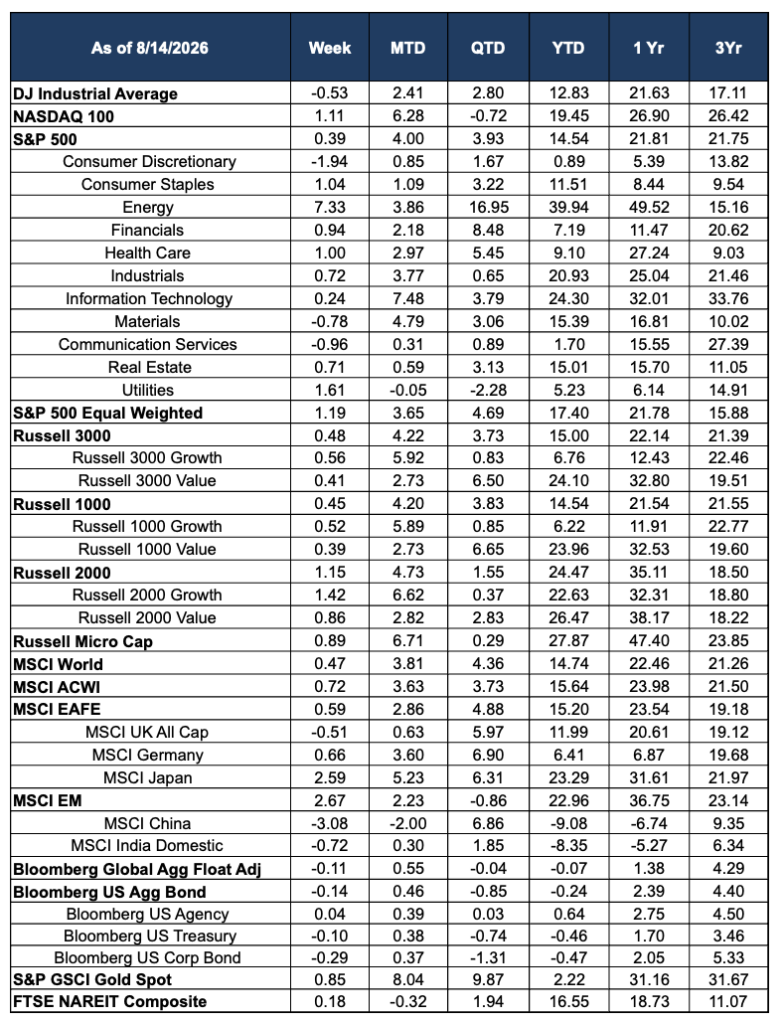
Source: Morningstar. Market data as of August 14, 2026. Past performance is not indicative of future results. The information provided is for educational and informational purposes only and does not constitute investment advice.