
Looking Ahead This Week: August 10, 2026
Friday’s July jobs report has fundamentally altered the Federal Reserve’s policy calculus in a matter of hours. With nonfarm payrolls falling an outright -23,000 — the first negative monthly print in years — and prior revisions stripping a combined 103,000 jobs from May and June, the Fed’s three dissenting hawks have been left without the labor market foundation their arguments required. Chair Warsh and the committee now face a sharply different set of circumstances than they did just two weeks ago at the July FOMC meeting. The key question this week is whether Fed officials respond publicly to the jobs data and in what direction: a measured acknowledgment of softening would provide further relief to markets, while any attempt to maintain a tightening bias in the face of negative payrolls would be a significant surprise.
The July Consumer Price Index, due Wednesday, August 12, will complete the picture. If the disinflationary trend established by June’s CPI holds — or accelerates, given continued progress in Strait of Hormuz energy normalization — the combination of a contracting labor market and falling inflation could prompt a genuine policy pivot from the FOMC by September. Markets will also be watching the University of Michigan Consumer Sentiment report on Friday for any read on whether household confidence has begun to crack alongside the deteriorating employment picture. Retail earnings season begins this week with Walmart and Home Depot reporting, providing early insight into whether the softening labor market is already showing up in consumer spending behavior.
Economic Data and Market Highlights: Week of August 4, 2026
Macro Backdrop
The July employment situation report, released Friday morning by the Bureau of Labor Statistics, delivered the most jarring labor market reading of the current economic cycle. Nonfarm payrolls fell by -23,000 in July — the first outright monthly decline since early 2025 and far below the Dow Jones consensus estimate of +83,000. The details were nearly uniformly weak: government payrolls fell 53,000, leisure and hospitality shed 40,000 positions, and retail employment contracted. Private payrolls added a modest 30,000 — insufficient to offset the government losses. The Bureau also revised its prior estimates dramatically lower: May’s gain was cut by 66,000 to just 63,000, and June’s figure — itself already revised to 57,000 from the original 172,000 — was cut further to only 20,000. The three-month average for job creation has now fallen to roughly 20,000 per month, a dramatic deceleration from the pace that characterized most of 2025.
Paradoxically, the headline unemployment rate edged down to 4.1% from 4.2% — but this reflected a further decline in labor force participation rather than genuine job growth, removing statistical comfort from the otherwise alarming number. Average hourly earnings rose just 3.2% year-over-year, the lowest reading since May 2021, confirming that the wage growth component of inflation is rapidly normalizing. The market reaction was swift and decisive: Treasury yields fell across the curve, gold surged, growth stocks recaptured months of losses in a single session, and rate-hike probability for the September and November FOMC meetings collapsed toward zero. The three FOMC members who dissented in favor of an immediate hike just one week prior have been left in a substantially weakened position by the data.
Domestic Equities
The S&P 500 surged +3.59% — its best weekly performance since the Iran ceasefire rally in the spring — as the devastating jobs report triggered a sharp repricing of the Federal Reserve’s trajectory and sent growth and technology assets sharply higher. Information Technology led all sectors with a gain of +7.22%, the sector’s largest single-week advance in 2026, driven by the combination of Apple’s exceptional fiscal third-quarter results reported after market close on July 31 and the sharp decline in rate expectations following the jobs report. Apple delivered another quarter of record-level Services revenue — now one of the company’s largest revenue contributors — and provided AI-upgrade cycle commentary that reassured investors concerned about demand for the next generation of iPhone hardware. The NASDAQ 100 surged +5.12%, nearly erasing its dismal July loss and bringing its year-to-date return to +18.14%.
Materials gained +5.61% and Industrials +3.03% as the broad market rally extended well beyond technology, with the equal-weighted S&P 500 advancing +2.43% — confirming that this week’s gains were broad-based rather than narrowly concentrated. Russell Micro Cap surged +5.77%, benefiting disproportionately from the collapse in rate-hike expectations that disproportionately helps smaller, more leveraged companies. The growth-versus-value dynamic that has defined 2026 showed a meaningful reversal this week, with Russell 1000 Growth advancing +5.35% compared to Russell 1000 Value’s +2.33%. Russell 1000 Growth’s year-to-date return has now climbed to +5.68% — still a fraction of Value’s +23.48% YTD — but the weekly dynamic suggests that the relentless rotation away from growth may be entering a new phase as the Fed’s tightening bias recedes. Energy was the sole notable laggard, falling -3.23% as the weak jobs report reignited concerns about the pace of domestic economic activity and the associated demand outlook for crude oil.
International Equities
International developed markets participated broadly in the week’s risk-on rally, with MSCI EAFE gaining +2.26% and the MSCI World index advancing +3.32%. MSCI Germany rose +2.92%, continuing its strong third-quarter rebound as improving energy supply conditions from the gradually reopening Strait of Hormuz provide incremental relief to Germany’s energy-intensive industrial base. MSCI Japan gained +2.57%, extending its year-to-date return to +20.17%, as yen dynamics stabilized and domestic corporate governance reforms continued to attract foreign institutional capital. MSCI UK All Cap was a relative laggard among developed markets at +1.15%, though the index maintains a solid +12.56% year-to-date return supported by its significant weightings in commodity-linked and financial sector companies.
Emerging markets were the notable exception to the week’s broad rally, with MSCI EM declining a modest -0.42% despite strong performances from MSCI China (+1.12%) and MSCI India Domestic (+1.03%). The divergence likely reflects the dollar’s complex reaction to the jobs report — weaker near-term on rate repricing, but the overall EM basket faced headwinds from idiosyncratic country-level factors and continued uncertainty about the pace of global trade normalization. MSCI China’s month-to-date gain of +1.12% extends a recovery that has now delivered +10.26% in the third quarter alone, though the year-to-date figure remains deeply negative at -6.19%, reflecting the weight of the first half’s selling pressure. The EM asset class retains a compelling +19.76% year-to-date return, underscoring the strength of the non-China emerging market universe throughout 2026.
Fixed Income
The bond market delivered its best weekly performance in months as the July jobs report caused Treasury yields to fall sharply across the curve. The Bloomberg US Aggregate Bond Index gained +0.60% for the week — one of its strongest weekly returns of the year — as the collapse in rate-hike expectations drove buying across Treasuries (+0.47%), corporate bonds (+0.66%), and agency debt (+0.35%). The market’s repricing was rapid and decisive: the probability of a September FOMC rate hike fell to near zero, and for the first time in several months, futures markets began pricing a small probability of a rate cut before year-end. The Bloomberg US Aggregate Bond Index, which had been mired near its year-to-date lows throughout July, is now essentially flat for the year at -0.09% — a significant recovery from the -1.30% monthly trough.
The medium-term fixed income outlook has shifted meaningfully in a single week. If July CPI — due Wednesday — confirms the disinflation trend, the combination of a contracting labor market and falling prices would make it exceedingly difficult for even the most hawkish FOMC members to sustain a tightening argument. The Bloomberg Global Aggregate Float Adjusted index gained +0.66% for the week, with international bond markets also benefiting from the repricing of U.S. rate expectations. The fixed income asset class, which absorbed persistent selling pressure throughout 2025 and the first half of 2026, may finally be approaching a sustained period of recovery — though the pace and durability of that recovery will depend heavily on the next several months of employment and inflation data.
Alternatives & Commodities
Gold surged +7.13% — its largest single-week gain since the peak of the Iran conflict — as the July jobs report triggered a simultaneous collapse in real yield expectations and a renewed flight to safe-haven assets. The metal’s year-to-date return turned decisively positive at +1.35%, recovering from a low of -6.11% reached in mid-July. The gold rally reflects a powerful combination of forces: falling nominal yields, declining inflation expectations (which paradoxically raises the metal’s appeal as confidence in the disinflation trade solidifies), and renewed uncertainty about the U.S. economic trajectory following a negative payrolls print. Whether this week’s surge marks the beginning of a sustained gold recovery or a reflexive overshoot of the rate repricing depends significantly on whether subsequent data confirms the labor market’s deterioration.
Energy gave back -3.23% for the week as negative payrolls data renewed concerns about domestic oil demand and partially unwound the supply-driven premium that has supported crude prices throughout the summer. The Energy sector’s year-to-date return slipped to +30.38% from its peak of +34.95% three weeks ago, though it remains by far the best-performing S&P 500 sector in 2026 — a remarkable testament to the depth and duration of the Strait of Hormuz supply shock. Real estate investment trusts (FTSE NAREIT Composite) declined a modest -0.50%, continuing to face headwinds from still-elevated absolute yield levels even as rate expectations shifted meaningfully lower. The sector’s year-to-date return of +16.34% reflects the substantial gains accumulated earlier in the year, before the Fed’s hawkish pivot reshaped the rate-sensitive landscape.
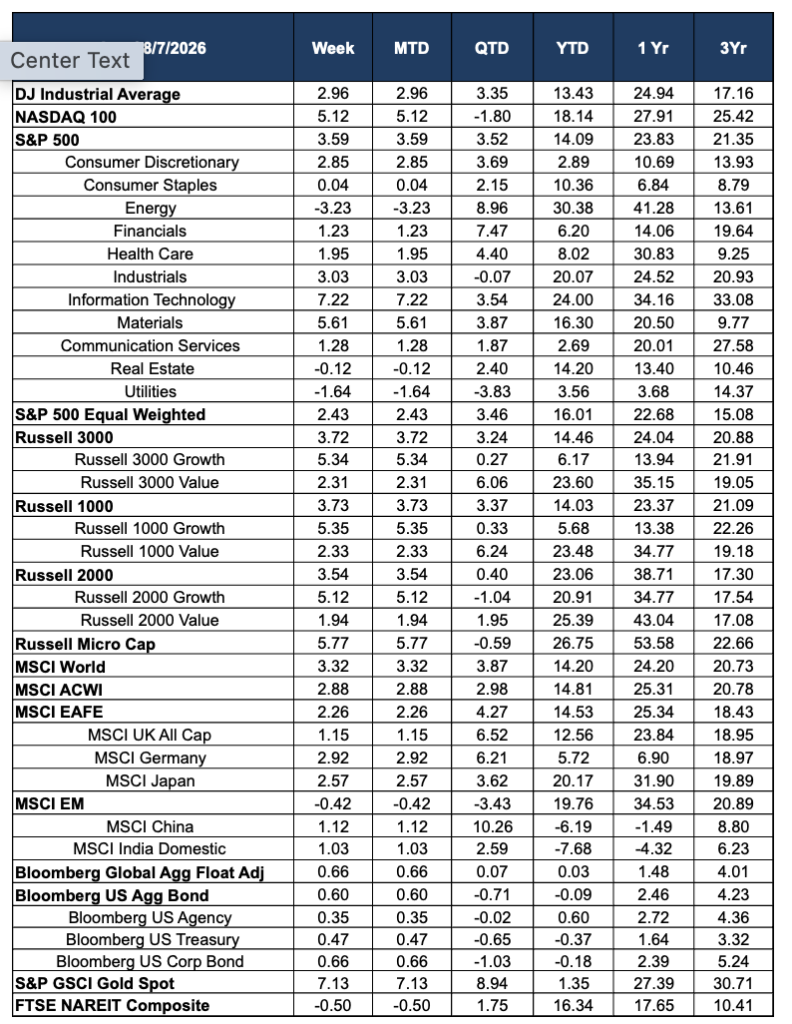
Source: Morningstar. Market data as of August 7, 2026. Past performance is not indicative of future results. The information provided is for educational and informational purposes only and does not constitute investment advice.