
Looking Ahead This Week: November 9, 2026
October inflation data takes center stage this week, arriving at a moment when the case for a December rate hike has strengthened considerably. The October CPI report on Tuesday is the most important release on the calendar, followed by October PPI on Friday. Forecasters generally expect monthly gains of around 0.2% for both headline and core CPI, a more moderate pace than September, as gasoline prices rose only marginally during the month. That forecast now carries more weight after Friday’s employment report: payrolls rose 165,000 in October, more than double expectations, and futures markets moved the probability of a quarter-point hike at the December 9 FOMC meeting to roughly 77%, up from about 67% a week earlier. A benign CPI print would not by itself remove the December hike from the table, but a hot one would likely make it a near-certainty. San Francisco Fed President Mary Daly said Friday that further tightening will likely be needed, and investors will be listening closely to other Fed officials for confirmation. Note that while U.S. equity markets are open on Wednesday for Veterans Day, the bond market is closed.
The earnings calendar thins out, but the reports that remain go directly to the question that drove last week’s selloff: whether the AI infrastructure buildout can continue at its current pace. CoreWeave reports Tuesday, Nebius on Thursday morning, and Cisco, Applied Materials, and Cerebras on Thursday after the close. These results will be read against a new political backdrop, as the midterm elections produced Democratic control of both chambers of Congress and a wave of state and local measures aimed at slowing data center construction. Beyond the U.S., the energy market will remain focused on U.S.-Iran diplomacy after oil posted its largest weekly decline since 2022 on reports that the two sides are moving closer to an agreement. With the S&P 500 now -3.51% for the quarter and Information Technology -13.26%, the combination of inflation data and AI earnings will set the tone for markets heading into the second half of November.
Economic Data and Market Highlights: Week of November 2, 2026
Macro Backdrop
The week of November 2 delivered three major catalysts in four days: the midterm elections, a sharp reversal in oil prices, and a much stronger-than-expected employment report. Democrats won control of both the House and the Senate on Tuesday, flipping at least seven Senate seats and more than two dozen House districts, along with several governorships, including Texas. Markets initially welcomed the result: on Wednesday the Dow gained roughly 1,569 points, its best post-midterm session in 44 years, as investors anticipated a divided government and oil prices fell sharply. The mood reversed abruptly on Thursday. More than 40 ballot measures aimed at slowing data center construction appeared on ballots across the country and most passed, while Texas, home to roughly a quarter of planned U.S. data center capacity by one estimate, elected a governor who has called for an immediate moratorium. Combined with weak results from Qualcomm and Arm, the outcome triggered a broad selloff in semiconductor and AI infrastructure stocks; the Philadelphia Semiconductor Index fell as much as 11% intraday and the S&P 500 lost more than 4% on the day.
Economic data was firm. The ISM Manufacturing index rose to 55.5 in October from 54.5, while ISM Services eased modestly to 54.5. Friday’s employment report was the week’s biggest surprise: nonfarm payrolls rose 165,000 against expectations of roughly 65,000, with August and September revised up by a combined 84,000. The unemployment rate declined to 4.1%, average hourly earnings rose 0.4% for the month and 3.1% year-over-year, and the labor force participation rate ticked up to 61.9%. The report substantially changes the narrative of the past two months, in which two payroll prints below 30,000 had been the strongest argument for Fed patience; the revised three-month average now stands at 137,000. The 2-year Treasury yield, the most policy-sensitive part of the curve, rose on Friday to finish the week at 4.51%, while the 10-year yield ended at 4.86%, still lower on the week as oil prices fell.
Energy markets saw their largest weekly move since 2022. Brent crude fell roughly 13% for the week to settle at $98.32 per barrel, and WTI fell to $90.83. The selling followed reports that the U.S. and Iran are moving closer to an agreement to end the conflict, with Tehran showing new flexibility on nuclear issues, and expectations that the midterm results will push the administration toward a faster resolution. The Strait of Hormuz has not fully reopened, and attacks on commercial vessels continue, but Saudi Arabia and the UAE have restored crude shipments to pre-war levels. Among corporate results, Apple reported fiscal fourth-quarter revenue of $114.5 billion, up 12% year-over-year and ahead of expectations, with iPhone revenue of $57.6 billion and earnings per share of $2.10 versus the $1.99 consensus. AMD reported data center revenue growth of 97%, but the stock was caught up in Thursday’s selloff along with Nvidia and Micron.
Domestic Equities
The S&P 500 declined -2.67% for the week, its worst week since June, bringing its quarter-to-date return to -3.51%. The Dow Jones Industrial Average held up comparatively well, falling -0.94%. Information Technology was the epicenter of the selloff, declining -6.93% for the week and -13.26% for the quarter, as the AI infrastructure trade unwound on political and earnings concerns. Energy fell -11.88% as oil prices retreated on Iran peace hopes; the sector’s year-to-date return has fallen from +59.92% to +40.92% in a single week, though it remains the strongest sector of 2026. Industrials, with significant exposure to data center construction and electrical equipment, declined -2.82%. On the other side of the ledger, Consumer Discretionary led with a gain of +2.68%, followed by Communication Services (+2.26%), which recovered a portion of the prior week’s Alphabet-driven decline, Real Estate (+1.88%), Financials (+1.14%), and Consumer Staples (+0.97%). The S&P 500 Equal Weighted index fell -1.04%, again outperforming the cap-weighted index, this time by 163 basis points; quarter-to-date, the equal-weighted index is +3.90% against -3.51% for the S&P 500.
The style divergence that has defined the fall widened further. Russell 1000 Growth fell -4.99% for the week, while Russell 1000 Value declined just -0.50%. Year-to-date, Russell 1000 Growth is now -5.15%, against +23.88% for Russell 1000 Value, a gap of more than 29 percentage points. Small caps were not spared: the Russell 2000 fell -2.03%, with Russell 2000 Growth (-2.31%) trailing Russell 2000 Value (-1.76%), and the Russell Micro Cap declined -3.33%. The broader Russell 3000 fell -2.53% and is now +8.88% year-to-date. The week’s pattern of leadership is notable: the sectors that gained, led by Consumer Discretionary and Financials, are those most directly supported by a resilient labor market and lower energy prices, while the decliners were concentrated in AI-linked technology and energy, the two dominant themes of the year.
International Equities
International developed markets declined, though less than the U.S., with MSCI EAFE falling -1.84%. Japan was the clear exception: MSCI Japan fell -7.48% and is now -11.34% for the quarter, as the global reassessment of semiconductor and AI infrastructure valuations weighed heavily on the country’s chip equipment and technology names. MSCI UK All Cap declined -0.65% after the Bank of England raised its policy rate by 25 basis points to 4.00%, its first hike since 2023. All nine members of the Monetary Policy Committee voted to raise rates, with one preferring a larger half-point increase, and the Bank now expects UK inflation to peak near 5% in the second quarter of 2027. MSCI Germany slipped -0.25%. The Reserve Bank of Australia also raised rates on Tuesday, lifting its cash rate to 4.85% in a split 6–3 vote. MSCI World declined -2.50% and MSCI ACWI fell -2.67%.
Emerging markets fell -4.07% (MSCI EM), bringing the asset class to -11.79% quarter-to-date, as heavy losses in South Korea and Taiwan, both concentrated in semiconductors, outweighed strength elsewhere. The week’s two standout performers were among the year’s weakest markets. MSCI India Domestic surged +8.99%, as Indian equities posted their strongest week since 2021 and the sharp decline in oil prices eased the import cost pressure that has weighed on the country all year; the index is now +10.39% for the quarter, though still -6.17% year-to-date. MSCI China rebounded +5.36%, led by Hong Kong-listed shares, narrowing its year-to-date loss to -13.51% after twelve consecutive weekly declines in mainland equities. Lower energy prices and comparatively limited exposure to the AI hardware trade helped both markets.
Fixed Income
Fixed income posted a fifth consecutive positive week, though gains were more modest as Friday’s employment report pushed short-term yields higher. The Bloomberg US Aggregate Bond Index gained +0.39%, and Bloomberg US Treasuries returned +0.31%. The Aggregate is now +2.85% for the quarter and has narrowed its year-to-date loss to just -0.15%. Bloomberg US Corporate Bonds gained +0.41%, with credit markets remaining orderly despite the equity selloff. The Bloomberg US Agency index added +0.29% and is +0.57% year-to-date. The Bloomberg Global Aggregate Float Adjusted index gained +0.35% and has improved to -0.91% year-to-date.
The fixed income backdrop has become more complicated. The decline in oil prices is a clear positive for the inflation outlook and helped pull the 10-year yield lower over the week. But the strength of the October employment report, and the upward revisions to prior months, removed much of the labor market weakness that had supported the bond rally since late September. The front end of the curve now reflects a high probability of a December hike, and Tuesday’s CPI report will determine whether that expectation firms further. For investors, the past five weeks have again demonstrated the diversification value of high-quality fixed income: in a week when the S&P 500 fell -2.67% and emerging markets -4.07%, the Aggregate delivered a positive return, and its starting yields continue to provide meaningful income.
Alternatives & Commodities
Gold rebounded +4.69% for the week, narrowing its year-to-date loss to -5.98%. The rally came early in the week, as falling oil prices eased concerns about further Fed tightening and the equity selloff renewed demand for defensive assets. Gold gave back some ground on Friday after the strong payroll report lifted the dollar and short-term yields, a reminder that the metal continues to trade primarily on the outlook for real rates.
Energy fell -11.88% for the week as Brent crude dropped below $100 per barrel. The sector remains up +40.92% year-to-date, and its trajectory from here depends heavily on whether U.S.-Iran talks produce a durable agreement and a full reopening of the Strait of Hormuz; until then, ongoing attacks on shipping leave meaningful upside risk to prices. Real estate investment trusts (FTSE NAREIT Composite) gained +1.86% for the week and are now +13.81% year-to-date, supported by lower long-term yields and the market’s rotation toward rate-sensitive and domestically focused sectors.
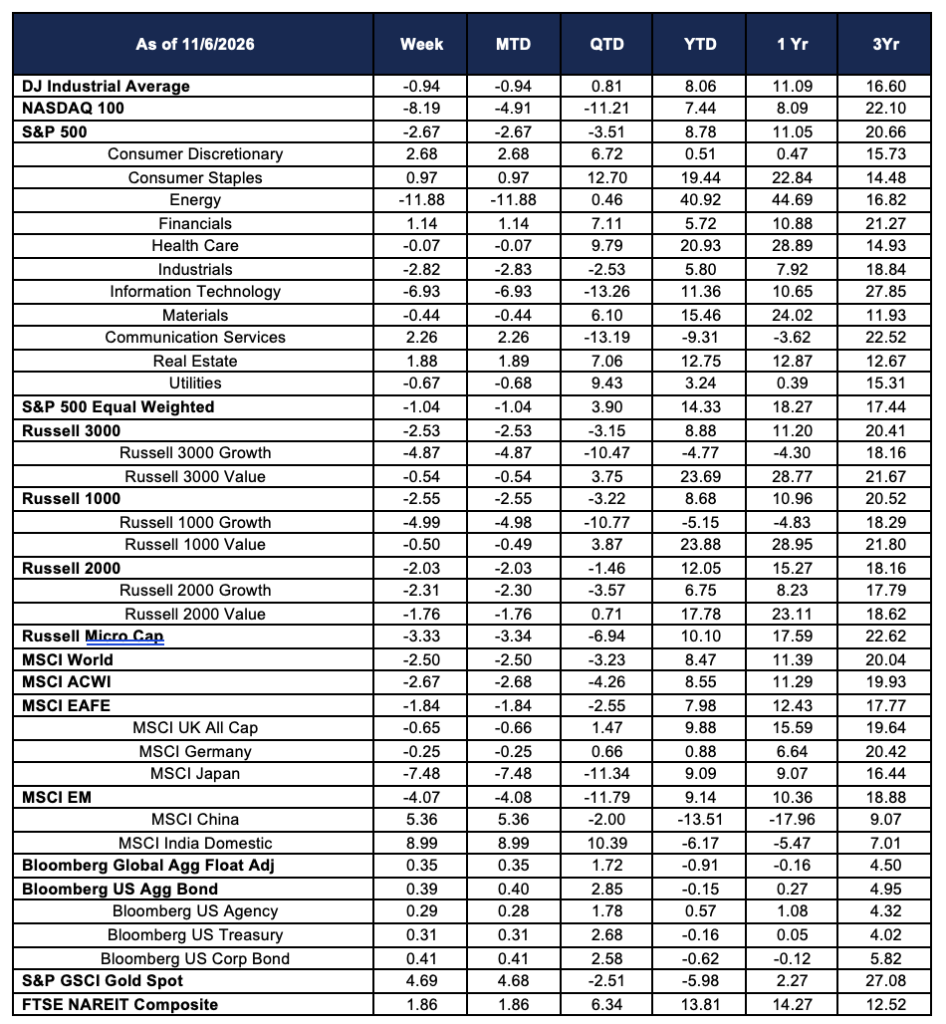
Source: Morningstar. Market data as of November 6, 2026. Past performance is not indicative of future results. The information provided is for educational and informational purposes only and does not constitute investment advice.