
Looking Ahead This Week: October 26, 2026
The Federal Open Market Committee meets Tuesday and Wednesday, October 27-28, for what may be the most finely balanced policy decision of Chair Warsh’s tenure. The committee enters the meeting with an uncomfortable set of facts on the table: headline CPI re-accelerated to 3.7% year-over-year in September, the Strait of Hormuz remains physically constrained with Brent crude elevated, and the September minutes showed most participants expecting at least one more increase before year-end. Against that, the labor market has produced two payroll reports below 30,000 in the past three months, wage growth has slowed to its weakest pace since 2021, and equity markets have absorbed a sharp correction in the technology complex. Warsh offered no clear guidance on the October decision in his remarks at the IMF meeting in Bangkok last Monday, preserving the committee’s optionality. Markets continue to treat a hold as the more likely outcome, with December viewed as the live meeting for a second hike, but the statement language and the press conference will be parsed for any signal that the committee’s patience is running short.
The FOMC decision lands in the middle of the heaviest stretch of the Q3 earnings season, with several of the largest remaining technology and consumer companies scheduled to report over the coming days. After a month in which Information Technology has declined -5.13% and Communication Services -7.23% quarter-to-date, those reports carry outsized weight for the direction of the cap-weighted indices heading into November. The question investors will be asking of each report is the same one that drove the October semiconductor selloff: whether AI-related capital spending is translating into revenue and margin growth quickly enough to justify the scale of the investment. Outside the U.S., the United Kingdom’s October 28 budget will be closely watched given elevated gilt yields, and Chinese equities enter the week near their lowest levels since mid-2025 after another difficult week. With the S&P 500 now essentially flat for the quarter at -0.31%, the combination of a Fed decision and peak earnings flow makes this week likely to set the tone for the remainder of the year.
Economic Data and Market Highlights: Week of October 19, 2026
Macro Backdrop
The week of October 19 was quieter on the economic calendar than the CPI-driven week before it, leaving corporate earnings and Fed positioning to set the tone. Chair Warsh spoke at the IMF meeting in Bangkok on Monday but deliberately avoided signaling the committee’s intentions for the October 27-28 meeting, a choice the market interpreted as a desire to keep both a hold and a hike on the table rather than pre-commit in either direction. Treasury yields eased modestly over the course of the week, with the Bloomberg US Treasury index gaining +0.55%, as investors weighed September’s hot inflation print against a labor market that has clearly lost momentum. Oil prices remained elevated, keeping the inflation backdrop firmly in focus and reinforcing the view that energy, not core goods or services, is the principal source of the re-acceleration in headline CPI. Core inflation has remained comparatively contained near 2.4%, which is the main argument in favor of patience; the headline print and the persistence of the Hormuz disruption are the main arguments against it.
The earnings season moved into its most consequential phase. Meta Platforms reported third-quarter revenue of $64.6 billion, up 26% year-over-year, driven by advertising strength, though reported operating income fell sharply to roughly $13.0 billion as a result of a large legal charge; excluding that charge, operating income was approximately $22.9 billion. Meta also narrowed its 2026 capital expenditure outlook, a closely watched figure after weeks of investor concern about the scale of AI infrastructure spending. Tesla reported revenue of $28.05 billion, flat year-over-year, with non-GAAP earnings of $0.48 per share ahead of the $0.45 consensus and deliveries of 486,532 vehicles comfortably above expectations; however, operating income declined substantially as research and development spending on autonomy, robotics, and AI compute rose, and shares traded lower after hours despite the beat. Taken together, the reports illustrated the market’s current posture toward large-cap technology: top-line strength is no longer sufficient on its own, and investors are scrutinizing the cost of the AI build-out as closely as the revenue it generates.
Domestic Equities
The S&P 500 slipped -0.46% for the week, while the Dow Jones Industrial Average gained +0.42% and the NASDAQ 100 declined -0.78%, extending the October pattern of large-cap growth underperformance into a third week. The standout move was in Communication Services, which fell -6.21% for the week and is now -3.08% year-to-date and -7.23% quarter-to-date, as earnings-season volatility among the sector’s largest constituents weighed heavily on a sector whose index weight is concentrated in a small number of mega-cap names. Information Technology declined a more modest -0.25%, suggesting the semiconductor selling of the prior two weeks may be stabilizing, though the sector remains -5.13% for the quarter. Industrials fell -1.87%. On the other side of the ledger, Energy gained +1.55% to bring its year-to-date return to +58.32%, Health Care advanced +1.47%, Utilities +0.82%, and Real Estate +0.86%. The S&P 500 Equal Weighted index gained +1.15%, outperforming the cap-weighted index by 161 basis points and continuing a month-long pattern in which the average stock has meaningfully outperformed the market’s largest names: the equal-weighted index is now +4.14% quarter-to-date against -0.31% for the cap-weighted S&P 500.
The week’s most notable reversal came in small caps. The Russell 2000 gained +2.02%, recovering a portion of the prior week’s -3.04% decline, with Russell 2000 Value up +2.09% and Russell 2000 Growth up +1.94%; the Russell Micro Cap rose +1.85%. The rebound was broad across style boxes, consistent with an easing in Treasury yields and with investors rotating toward domestically focused companies that have less exposure to the AI capital spending debate. In large caps, the style divergence persisted: Russell 1000 Value gained +0.67% while Russell 1000 Growth fell -1.52%. The year-to-date gap between the two now stands at more than 22 percentage points, with Russell 1000 Value at +23.90% and Russell 1000 Growth at just +1.55%, a striking reversal from earlier in the year when AI-linked growth leadership appeared unassailable. Consumer Staples gained +0.58% and has now returned +9.83% quarter-to-date, the second-best sector of Q4 behind Energy, a reflection of how decisively investor positioning has shifted toward defensive and inflation-resilient businesses this month.
International Equities
International developed markets gave back a portion of the prior week’s gains, with MSCI EAFE declining -1.51% for the week. MSCI UK All Cap fell -1.44% after its strong +4.16% advance the prior week, though it remains +1.62% for the quarter, and investors are now positioning ahead of the October 28 UK budget against a backdrop of elevated gilt yields. MSCI Germany declined -1.92%, returning to negative territory year-to-date at -1.10% as the country’s export-oriented industrial base continues to struggle with high energy costs and soft global manufacturing demand. MSCI Japan fell -1.73% and is now -3.84% quarter-to-date, weighed down in part by its own technology and semiconductor exposure, though its year-to-date return of +18.32% still ranks among the strongest of any major developed market. MSCI World declined -0.67% and MSCI ACWI fell -0.89%, with the broader global indices pulled lower by weakness outside the United States in a week when U.S. small caps and equal-weighted indices held up comparatively well.
Emerging markets fell -2.61% (MSCI EM), bringing the asset class to -7.37% quarter-to-date, the weakest quarterly start of any major equity category we track. China led the decline with MSCI China falling -4.49% to a year-to-date loss of -17.55% and a trailing one-year return of -21.11%. The weakness came despite third-quarter GDP growth of 4.5% and renewed calls from authorities for state-linked funds and companies to support the equity market. Investors focused instead on soft domestic demand, fading expectations for additional stimulus, and disappointing corporate results: battery maker CATL fell roughly 12% in a single session after reporting a sharp slowdown in third-quarter profit growth. Trade friction with the European Union, which has been weighing new measures against Chinese goods, added to the pressure. MSCI India Domestic gave back -3.15% after its sharp rebound the prior week, leaving its year-to-date loss at -15.76% as the country continues to absorb high energy import costs and currency pressure.
Fixed Income
Fixed income posted a third consecutive positive week, with the Bloomberg US Aggregate Bond Index gaining +0.54% and Bloomberg US Treasuries returning +0.55%. The Aggregate’s year-to-date return has improved to -1.10%, and the index is now +1.87% for the quarter, its best quarterly start of the year. The rally has been driven by a combination of factors: a softer labor market that has lowered expectations for the pace of further tightening, periodic flight-to-safety demand during the technology selloff, and a general sense that yields near multi-decade highs had already priced in a significant amount of policy risk. Bloomberg US Corporate Bonds gained +0.34% for the week and +1.68% for the quarter, with credit markets steady through earnings season as corporate results have, in aggregate, confirmed the resilience of balance sheets despite higher borrowing costs. The Bloomberg US Agency index added +0.26% and is now essentially flat for the year at -0.12%.
The Bloomberg Global Aggregate Float Adjusted index gained +0.24% for the week and has improved to -1.56% year-to-date. While the October recovery in bonds has been meaningful, it remains vulnerable to the outcome of this week’s FOMC meeting. A surprise hike, or a statement that leans clearly toward a December increase, would challenge the recent decline in yields, while a hold accompanied by balanced language could allow the recovery to extend. For investors, the October experience has been a useful reminder of the diversification role that high-quality fixed income can play: in a month when the NASDAQ 100 has declined -4.76% and emerging markets -7.37%, the Bloomberg US Aggregate has delivered positive returns. With starting yields at their highest levels in many years, the asset class offers income that can cushion portfolios against further equity volatility even if rates remain elevated for longer.
Alternatives & Commodities
Gold fell -4.14% for the week, its steepest weekly decline in some time, pushing its year-to-date return down to -7.68% and leaving it well below the record highs set in late January. The selling reflected the same forces that have weighed on the metal for much of the autumn: elevated real yields, expectations that the Federal Reserve is not yet finished tightening, and rising oil prices that have heightened inflation concerns in a way that, paradoxically, has been negative rather than positive for gold because of what it implies for Fed policy. The metal’s failure to benefit from equity market volatility and ongoing geopolitical risk this month underscores that, in the current environment, gold is trading primarily as a rate-sensitive asset. A clear signal from the Fed that it is prepared to pause could change that dynamic quickly; a hawkish outcome this week would likely extend the pressure.
Energy gained +1.55% for the week, pushing the sector’s year-to-date return to +58.32% and its quarter-to-date return to +12.86%, both by far the strongest of any S&P 500 sector. The Strait of Hormuz remains constrained and oil prices elevated, and there has been no meaningful diplomatic progress since Iran reversed its reopening signal earlier this month. The sector’s dominance in 2026 has been remarkable in both its magnitude and its persistence, and it continues to serve as one of the most effective hedges against the inflationary consequences of the supply disruption. Real estate investment trusts (FTSE NAREIT Composite) gained +1.23% for the week and are now +10.53% year-to-date, supported by the decline in Treasury yields over the past several weeks. Like fixed income, REITs have benefited from the October bond rally and will be sensitive to the tone of this week’s FOMC decision.
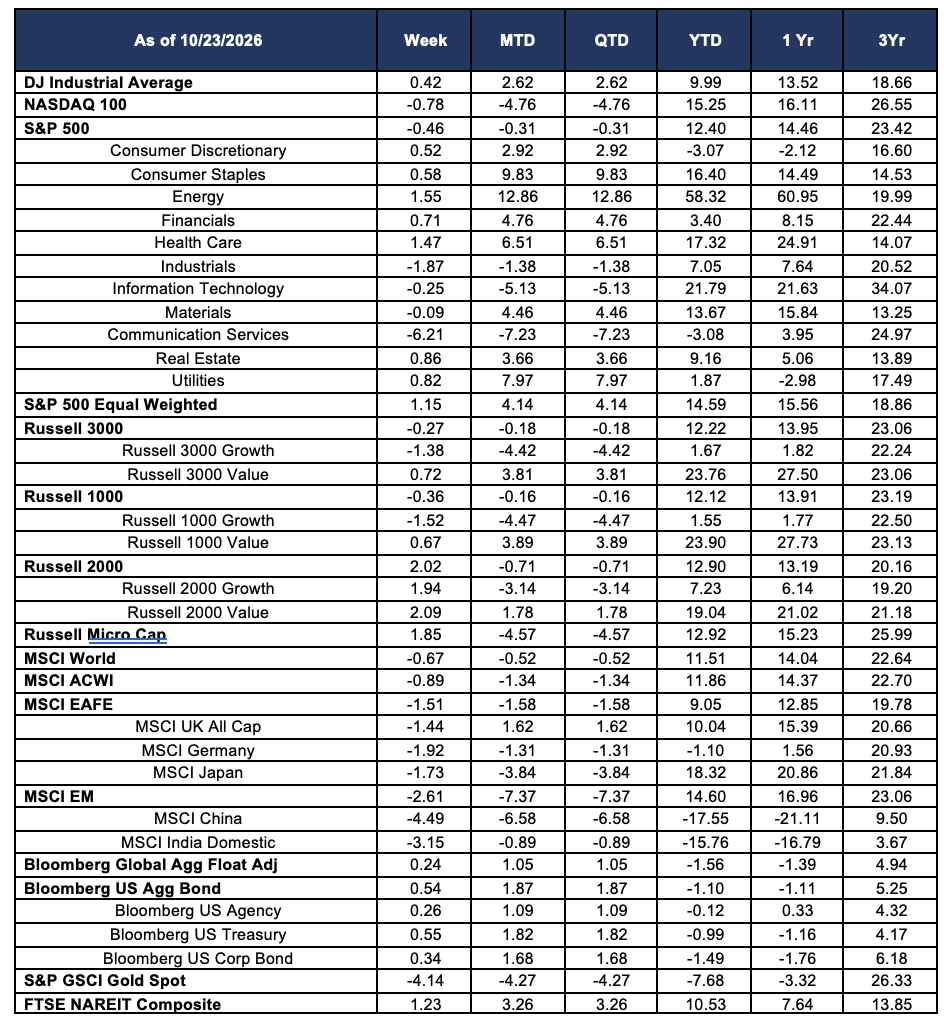
Source: Morningstar. Market data as of October 23, 2026. Past performance is not indicative of future results. The information provided is for educational and informational purposes only and does not constitute investment advice.