
Looking Ahead This Week: August 24, 2026
Markets will spend the week digesting Chair Warsh’s Jackson Hole address and translating its signal — or deliberate lack of one — into September FOMC positioning. Warsh arrived at the symposium describing his remarks as focused on long-term structural questions rather than near-term guidance, a framing that itself told a story: a Fed chair who has curtailed traditional forward guidance in a period of genuine economic uncertainty is unlikely to deliver the clear pivot markets have been seeking. The September meeting, now three weeks away, is shaping up as one of the most consequential since the tightening cycle began, with a labor market that has contracted for two consecutive months, a core CPI that has fallen to 2.5%, and an energy supply shock that refuses to resolve. The market’s task this week is to price all three simultaneously.
The pace of Strait of Hormuz diplomatic progress will remain the second dominant variable. Iran’s expanded list of conditions — sanctions relief, an end to U.S. military threats, and financial compensation — has so far produced no meaningful breakthrough, and the resumed tanker attacks in late July have added physical risk to what had briefly appeared to be a political negotiation. With Brent crude holding above $84 per barrel and the Energy sector now up +44.05% year-to-date, any credible diplomatic development has the potential to trigger a sharp sectoral rotation. The health care sector’s remarkable acceleration — now up +29.76% year-to-date after gaining more than 10% in August alone — will also be tested as the AI-driven pharmaceutical pipeline story moves from sentiment to data, with several Phase 3 obesity and GLP-1 drug readouts approaching in the weeks ahead.
Economic Data and Market Highlights: Week of August 18, 2026
Macro Backdrop
The week was defined by the buildup to Federal Reserve Chair Kevin Warsh’s first Jackson Hole keynote address, delivered Friday at the Kansas City Fed’s annual Economic Policy Symposium. Markets spent the week navigating a deeply uncertain policy landscape: 30-year Treasury yields hovered near 5.2%, September rate-hike odds stood at roughly one-in-three, and the FOMC’s internal division — a 9-3 vote at the July meeting — had created an unusual degree of uncertainty about the committee’s direction. Warsh, who has deliberately curtailed the Fed’s tradition of forward guidance, arrived at Jackson Hole with remarks described as structural rather than tactical in focus, offering markets little of the near-term clarity they sought. The combination of elevated long yields, an unresolved energy supply shock, and the specter of a stagflationary environment — contracting employment alongside persistent above-target inflation — weighed on equity markets broadly for the week.
The economic context heading into Jackson Hole is genuinely unprecedented in the current cycle. Two consecutive months of sharply negative or negligible payroll growth (July’s -23,000 following a revised June of only 20,000), a core CPI that has fallen to 2.5% annually, and an energy sector still absorbing the Strait of Hormuz supply shock have produced a policy trilemma with no clean resolution. Hiking into a contracting labor market risks deepening a recession; holding risks allowing energy-driven inflation to re-accelerate; cutting would directly contradict the message delivered by three hawkish dissenters as recently as three weeks ago. Gold’s surge of +5.48% for the week — its second consecutive week of substantial gains and now up +13.97% in August alone — reflects the market’s growing conviction that stagflation, rather than either orderly disinflation or straightforward recession, is the dominant near-term risk.
Domestic Equities
The S&P 500 fell -1.39% for the week as broad-based selling hit growth, cyclical, and rate-sensitive sectors alike. Information Technology declined -3.18% — its worst week since the July AI earnings selloff — as the re-acceleration of long-term Treasury yields toward the 5.2% range on the 30-year reintroduced the discount rate concerns that have plagued the sector throughout 2026. Industrials fell -3.37%, reflecting both rate sensitivity and growing concern that a contracting labor market will translate into weaker capital expenditure and project demand. Utilities plunged -3.49% for the week, extending their third-quarter loss to -5.70% — a remarkable deterioration for a sector typically considered defensive, driven entirely by the persistence of elevated long-term yields that make utility dividend yields less competitive with Treasury alternatives.
Health Care was the week’s decisive outlier, surging +4.33% and extending its extraordinary August run to +10.02% month-to-date — making it the second-best performing S&P 500 sector year-to-date at +29.76%, trailing only Energy’s +44.05%. The sector’s acceleration reflects a convergence of powerful structural catalysts: AI-driven drug discovery platforms are compressing pharmaceutical research timelines dramatically, the GLP-1 and obesity treatment pipeline has matured from a single-stock story into a broad, tiered investment opportunity, and multiple Phase 3 clinical readouts are approaching across the biotech complex. Biotech ETFs have surged more than 50% since June 1, driven in part by the same AI application thesis that has fueled technology sector enthusiasm — but with the added catalyst of tangible near-term revenue milestones in the form of FDA approvals and drug launches. Energy continued its relentless advance, gaining +2.94% as Brent crude held above $84 per barrel amid Iran’s unresolved demands. Materials also outperformed at +2.34%, benefiting from both commodity price dynamics and the weaker dollar. The equal-weighted S&P 500 fell -0.49%, with the divergence between the cap-weighted decline and the equal-weighted result reflecting the outsized drag from mega-cap technology names.
International Equities
International equity markets diverged sharply. MSCI EAFE fell -0.54% overall, masking a striking divide between regional markets. MSCI Japan declined -3.33% — its worst week in months — as yen strength returned with a force that punished Japanese exporters and semiconductor names. The yen’s appreciation during the week likely reflected safe-haven flows driven by the combination of global equity weakness, stagflation fears, and the anticipation of Warsh’s uncertain Jackson Hole message. Japan’s export-oriented equity market is acutely sensitive to currency moves, and the speed of the yen’s strengthening overwhelmed the positive structural narrative that had driven the Nikkei’s +19.18% year-to-date gain. MSCI UK All Cap was a notable exception, gaining +1.10%, supported by the UK index’s heavy weighting toward value-oriented energy, financial, and consumer staples names that fared relatively well in the week’s rotation.
Emerging markets held up considerably better than developed markets, with MSCI EM gaining +1.24% for the week — a significant reversal from its pattern of underperformance during risk-off episodes earlier in 2026. MSCI China advanced +2.94%, its third consecutive week of positive returns, driven by continued domestic policy support and improving sentiment around consumer spending as Chinese energy import costs benefited from government subsidy adjustments. The EM asset class year-to-date return now stands at +24.49%, anchored by the strength of non-China emerging economies across Southeast Asia and Latin America. MSCI India Domestic fell -0.71%, continuing its difficult year — the index is now -9.00% year-to-date — as elevated energy import costs and currency pressure persist as structural headwinds for the domestic economy.
Fixed Income
Fixed income markets posted a modestly negative week as 30-year Treasury yields hovered near 5.2% in advance of Chair Warsh’s Friday remarks. The Bloomberg US Aggregate Bond Index fell -0.10%, with U.S. Treasuries declining -0.08% and investment-grade corporate bonds down -0.15%. The week’s bond market behavior reflected a market caught between competing impulses: the continued accumulation of softening labor market and inflation data that would normally support a bond rally, and the structural supply-and-demand imbalance in Treasury markets that has kept long yields elevated even as short-term rate expectations have shifted. The 30-year Treasury yield at approximately 5.2% represents one of the highest levels in more than two decades, and its persistence despite improving inflation data suggests that term premium — investors’ compensation for holding long-duration risk — has risen substantially in 2026.
The medium-term fixed income outlook hinges significantly on the September FOMC meeting and its aftermath. If Warsh’s Jackson Hole remarks are interpreted as signaling a genuine hold without further tightening bias, the September meeting could provide the catalyst for a sustained decline in yields and a meaningful fixed income recovery. If, conversely, the committee chooses to hike despite the deteriorating labor market — citing the Hormuz-driven energy price reacceleration — fixed income markets will face a difficult final quarter of 2026. The Bloomberg US Aggregate Bond Index sits at -0.34% year-to-date, and the Bloomberg Global Aggregate Float Adjusted index has recovered to a barely positive +0.11% YTD, reflecting the relative resilience of international sovereign bond markets throughout the summer.
Alternatives & Commodities
Gold surged +5.48% for the week — its second consecutive weekly gain of more than 5% — extending its August rally to +13.97% and pushing its year-to-date return firmly into positive territory at +7.82%. The metal’s resurgence reflects a powerful and increasingly coherent set of tailwinds: declining real yield expectations as the labor market contracts, renewed geopolitical risk premium from the Hormuz re-escalation, and growing market conviction that the near-term risk scenario is stagflationary rather than cleanly disinflationary. In this environment, gold functions simultaneously as a monetary hedge, a geopolitical safe haven, and an alternative to bonds that are offering historically elevated nominal yields but still-uncertain real returns. The trailing twelve-month return of +38.41% captures the full arc of gold’s extraordinary 2026 journey — from conflict-driven peak to summer selloff to renewed recovery.
Energy gained +2.94% for the week as Brent crude maintained its elevated range above $84 per barrel, sustained by Iran’s unresolved demands and the continued physical constraints on tanker traffic through the Strait of Hormuz. The sector’s year-to-date return of +44.05% is now approaching levels that would represent one of the most remarkable annual sector performances in modern market history. Materials advanced +2.34%, finding support from both commodity price dynamics and a modestly weaker U.S. dollar. Real estate investment trusts (FTSE NAREIT Composite) fell -0.36%, continuing to face headwinds from the 30-year Treasury yield’s proximity to 5.2% that limits capital’s willingness to pay premium valuations for real estate cash flows — despite the sector’s still-solid +16.13% year-to-date return.
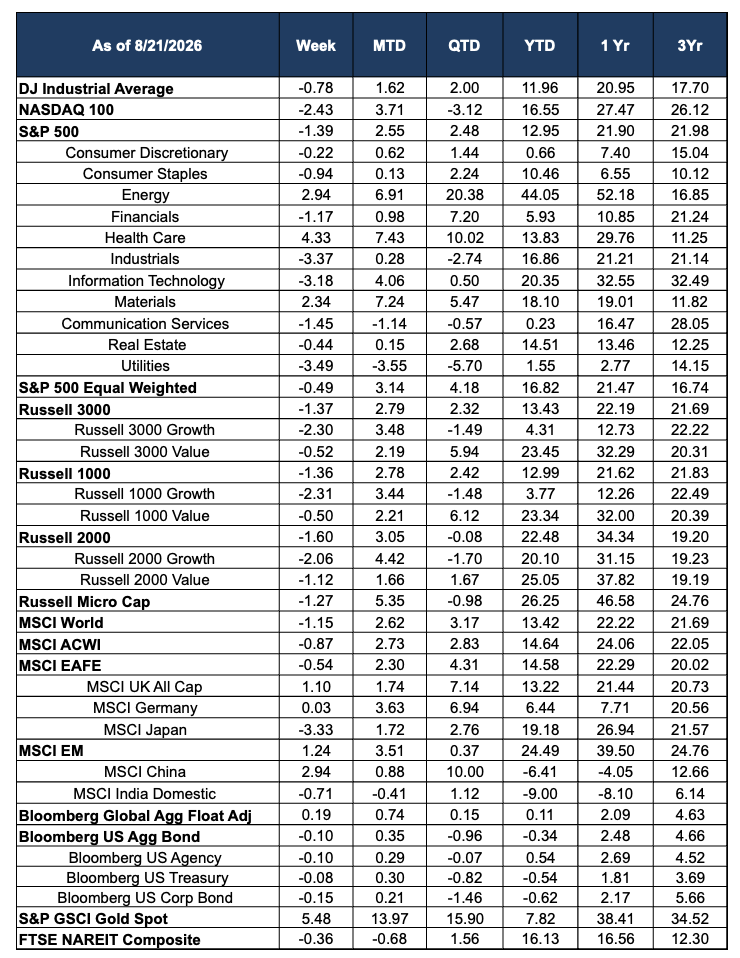
Source: Morningstar. Market data as of August 21, 2026. Past performance is not indicative of future results. The information provided is for educational and informational purposes only and does not constitute investment advice.