
Looking Ahead This Week: August 3, 2026
The July jobs report on Friday, August 7 is the week’s most consequential data point, arriving at a particularly sensitive juncture for monetary policy. Three Federal Reserve regional presidents dissented in favor of an immediate rate hike at last week’s FOMC meeting — the largest hawkish dissent count since the early phase of the 2022-2023 tightening cycle — and any sign of labor market re-acceleration will sharply amplify market pricing for a September or November hike. Conversely, a soft print consistent with the June payrolls deceleration would provide meaningful relief for rate-sensitive assets, which absorbed severe losses last week as Utilities fell more than 4% and REITs declined more than 2% on the Fed’s uncompromising tone. The unemployment rate and average hourly earnings will be as important as the headline payrolls number in shaping that interpretation.
Apple is expected to report second-quarter earnings this week in what will be the final major technology report of Q2 season. The result arrives against a backdrop that is equal parts cautionary and constructive: Meta missed EPS estimates by nearly 14% last week on legal costs and AI capex that consumed virtually all of its free cash flow, while Amazon surged on the strength of AWS. Investors will be watching Apple’s services revenue growth — where AI monetization is most tangible — alongside any guidance on AI hardware upgrade cycles in the iPhone lineup. The emerging pattern of the quarter, in which revenue growth is broadly strong but aggressive AI capital expenditure is compressing near-term cash flow, will be tested again.
Economic Data and Market Highlights: Week of July 28, 2026
Macro Backdrop
The Federal Open Market Committee held the federal funds rate at 3.50-3.75% at its July 28-29 meeting in what was described widely as a divided hold. The 9-3 vote in favor of maintaining rates was the most contested FOMC decision in years, with regional presidents Hammack (Cleveland), Kashkari (Minneapolis), and Logan (Dallas) all dissenting in favor of an immediate 25-basis-point rate hike. Their argument: inflation has remained above the Fed’s 2% target for more than five years, the labor market has not deteriorated sufficiently to justify patience, and the June CPI improvement — driven largely by gasoline prices rather than core services — does not represent durable disinflation. Fed year-end rate projections remain in a range of 3.6% to 4.1%, and markets continue to price two 25-basis-point hikes before year-end. Chair Warsh’s measured public tone did not fully offset the hawkish signal embedded in three dissents.
The market’s reaction was immediate and sector-specific. Rate-sensitive assets that had rallied on hopes of a genuinely dovish pivot absorbed severe losses: Utilities fell -4.21% for the week — among the worst weekly performances for the sector in 2026 — and the FTSE NAREIT Composite dropped -2.27%, as investors rapidly repriced the probability that borrowing costs will remain elevated through at least the end of the year. The Bloomberg US Aggregate Bond Index ended the week modestly lower at -0.12%, though the monthly picture is more sobering — the index fell -1.30% in July as yields remained stubbornly elevated throughout the month. The 10-year Treasury yield ended July still near its year-to-date highs, reflecting the persistence of the FOMC’s tightening bias even in the face of meaningfully better inflation data.
Domestic Equities
The broad market recovered solidly despite the Fed’s hawkish tone, with the S&P 500 gaining +1.06% for the week on the back of two contrasting technology earnings reports that together helped clarify the AI investment landscape. Amazon reported second-quarter results on July 30 that exceeded expectations across nearly every dimension: revenue grew 20% year-over-year to $200.6 billion, AWS cloud segment revenue surged 37% to $42.2 billion, and EPS of $1.97 beat the $1.82 consensus estimate. Amazon shares rose approximately 10% on the report, delivering a powerful boost to Consumer Discretionary (+2.27%) and to investor confidence that the cloud infrastructure buildout is generating measurable financial returns. The company’s Q3 revenue guidance of $197-$202 billion came in slightly below the $204 billion consensus, but investors appeared willing to look through the near-term conservatism given the AWS result.
Meta’s earnings on July 29 told a more complicated story. Revenue grew 28% year-over-year to $60.8 billion — a genuinely strong top-line result — but EPS of $6.18 missed estimates of $7.17 by nearly 14%. The miss reflected $2.4 billion in legal expenses, $1.18 billion in severance costs related to 8,000 layoffs, and higher-than-expected depreciation from accelerating AI infrastructure investment. The most striking figure: $31.1 billion in capital expenditures consumed virtually all of the company’s $31.9 billion in operating cash flow, compressing free cash flow from $8.5 billion a year ago to just $784 million. Meta shares fell approximately 9.6% in after-hours trading. The week’s divergence between Amazon (AI spending generating returns in cloud) and Meta (AI spending consuming near-term cash flow) crystallized the central debate that has dominated Q2 earnings season. The equal-weighted S&P 500 gained +0.64%, and the growth-value divergence that has defined 2026 reached a new extreme: Russell 1000 Growth is barely positive year-to-date at +0.32%, while Russell 1000 Value stands at +20.67% YTD — a spread of more than 20 percentage points.
International Equities
International developed markets posted their strongest collective week in months, with MSCI EAFE gaining +2.02% as European and Japanese equities benefited from improving global trade sentiment and a modestly weaker U.S. dollar following the Fed’s hold decision. MSCI Germany was the standout, surging +3.52% — its best weekly performance since the Iran ceasefire — as improving energy import costs and signs of stabilization in German industrial orders provided a more constructive backdrop for Europe’s largest economy. MSCI UK All Cap gained +2.09% and MSCI Japan advanced +2.54%, with Japanese equities continuing their recovery from the prior month’s semiconductor-driven selloff. July closes with MSCI EAFE up +12.00% year-to-date, a strong performance that reflects both currency tailwinds and the relative benefit of lower technology sector concentration compared to U.S. indices.
Emerging markets turned in one of their strongest weeks of the quarter, with MSCI EM gaining +2.37%. MSCI China surged +3.94% — extending its monthly gain to +9.04%, the best month for Chinese equities in 2026 — as a combination of domestic policy stimulus, improved consumer confidence, and receding Strait of Hormuz energy costs provided an unusually constructive short-term backdrop. MSCI India Domestic bounced +3.81%, partially recovering from months of underperformance, as currency stabilization and improving sentiment about the global rate path aided the market. Despite July’s difficult conditions for emerging markets broadly (-3.03% MTD for MSCI EM), the asset class retains a compelling year-to-date return of +20.27%, anchored by the broad non-China emerging universe and the continuing structural growth story across Southeast Asia and Latin America.
Fixed Income
Fixed income ended July in deeply negative territory for the month, with the Bloomberg US Aggregate Bond Index falling -1.30% in July — now -0.69% year-to-date after briefly turning positive earlier in the summer. The Bloomberg US Corporate Bond index declined -1.67% for the month, and U.S. Treasuries fell -1.11% MTD as the combination of a hawkish FOMC dissent, persistent Treasury supply, and still-elevated inflation expectations held yields near multi-year highs. The 10-year Treasury ended the month still near the 4.7% year-to-date highs established in mid-July, with the 2-month T-bill yield implying that markets have not fully dismissed the possibility of a rate hike by year-end. For the week specifically, the bond market was modestly negative at -0.12% (US Agg), suggesting the FOMC hold provided some stability even if the hawkish tone prevented a meaningful rally.
The fixed income picture remains challenging but not without hope. The June CPI improvement and the trajectory of June and July labor market data provide the Fed’s doves with legitimate arguments for continued patience, and if August payrolls data show further deceleration, the probability of rate hikes in the fall may diminish enough to allow yields to ease from their current elevated levels. The Bloomberg Global Aggregate Float Adjusted index gained +0.58% for the week on the strength of international bond markets, though it remains -0.62% year-to-date, reflecting the broad global tightening environment that has persisted throughout 2026.
Alternatives & Commodities
Gold declined modestly at -0.55% for the week, remaining unable to break its year-to-date downtrend despite persistent geopolitical and monetary policy uncertainty. The metal is -5.39% year-to-date, a striking reversal from its early-2026 highs when it served as a primary beneficiary of the Iran conflict’s risk premium. The continued elevation in real yields — driven by a Fed that shows no willingness to meaningfully soften its posture despite improving inflation data — remains the primary headwind for non-yielding precious metals. Gold’s trailing twelve-month return of +22.65% still reflects the magnitude of the early-2026 safe-haven bid, but the recovery from that episode has proved more durable for equities and real assets than for the metal itself.
Energy ended the week essentially flat at -0.16%, consolidating after its extraordinary July, which delivered a +12.60% monthly gain that brought the sector’s year-to-date return to +34.74% — by far the best-performing major asset class of 2026. The physical reopening of the Strait of Hormuz continues to be a slow process constrained by ongoing de-mining operations, vessel inspection requirements, and insurance market normalization, providing a persistent floor under oil prices even as geopolitical risk premium has largely unwound. Real estate investment trusts (FTSE NAREIT Composite) fell -2.27% on the week as the Fed’s hawkish dissents renewed investor concerns about the duration of elevated rates, pushing the sector’s July monthly return to +2.26% despite the painful week — a reminder of how much REITs had recovered entering the FOMC meeting.
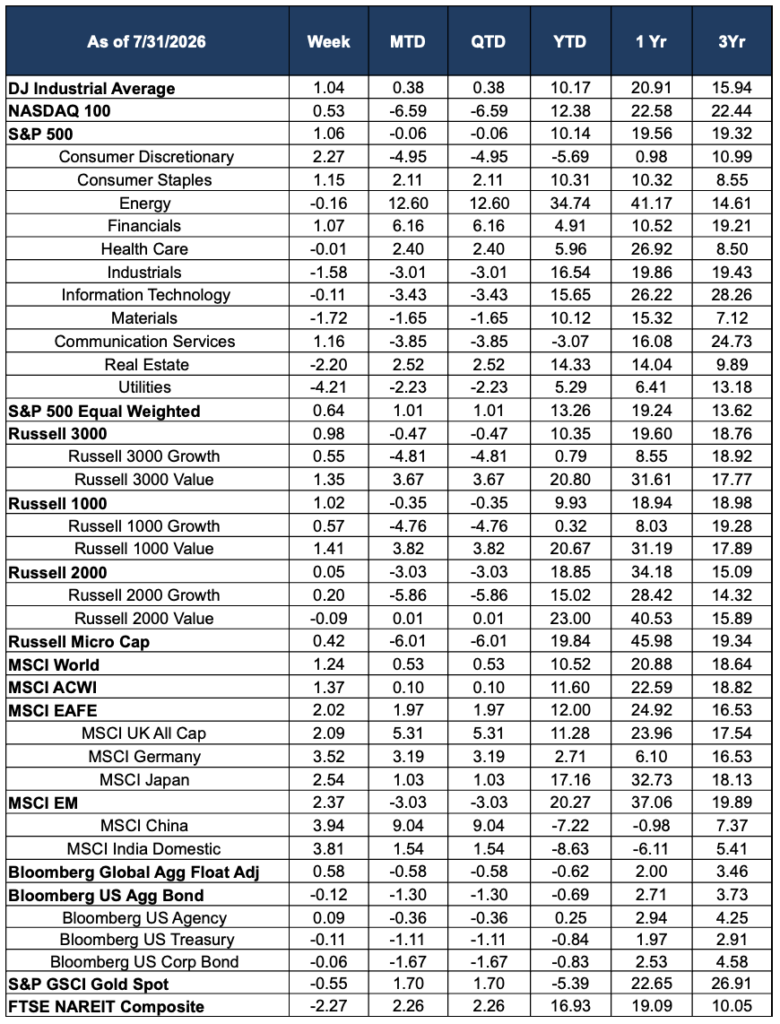
Source: Morningstar. Market data as of July 31, 2026. Past performance is not indicative of future results. The information provided is for educational and informational purposes only and does not constitute investment advice.